Differential and transfer case fluid explained: how the gears work, gear oil weights, and how to fill it
Published . Every interval is from an owner's manual; the rest is from an axle maker's lubrication manual or a named trade source, linked in the sources.
The short answer
- A differential turns the driveshaft's power 90 degrees to the wheels and lets the two wheels on an axle turn at different speeds in a corner. A 4WD truck has one in each axle and a transfer case that splits the power between them.
- Its gears run in a small bath of gear oil with no pump and, in most axles, no filter. The ring gear dips into the oil and flings it over the gears and bearings.
- Axle gear teeth slide under very high pressure, so gear oil carries sulfur-phosphorus additives. That sulfur is the rotten-egg smell.
- The fill plug is the level gauge: on level ground, fill until the oil reaches the bottom of the fill hole. More than that gets churned into foam and runs hot.
- 75W-90 and 75W-140 are thickness grades; GL-5 is the rating for hypoid axles. Use the grade your owner's manual lists - a transfer case usually takes a different fluid.
Where the power goes: transmission, transfer case, driveshafts, axles
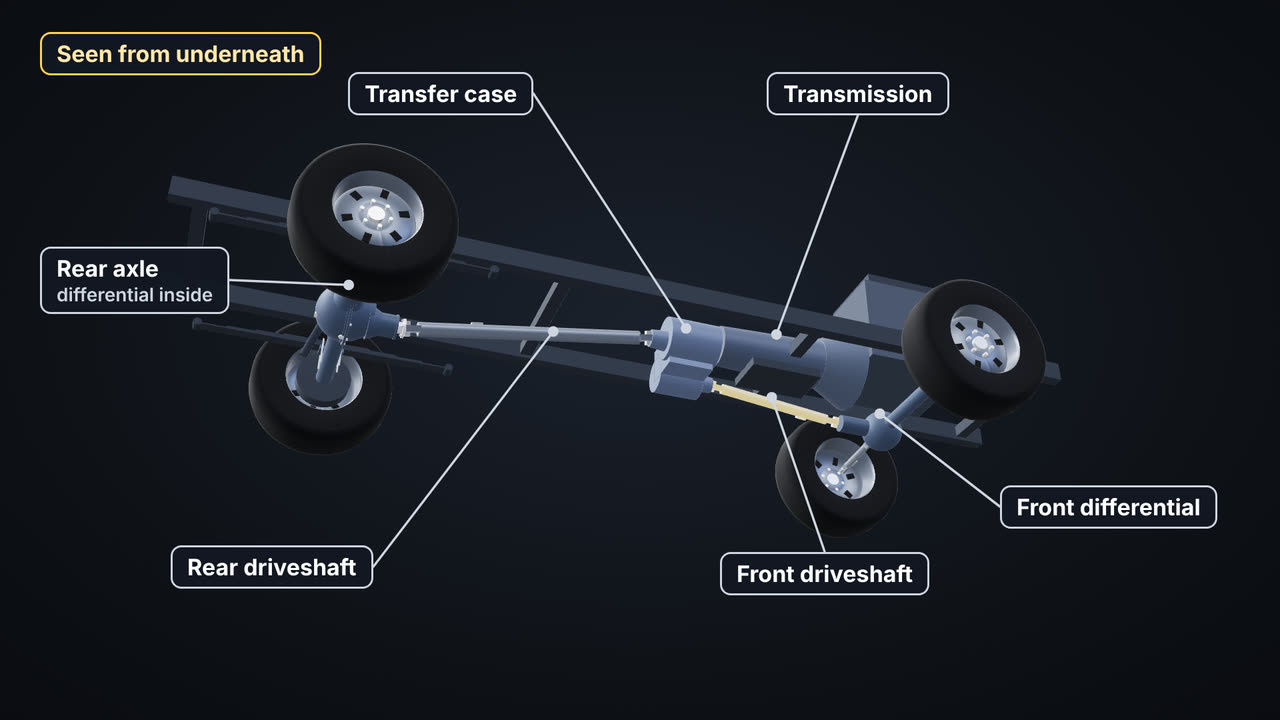
In a rear-wheel-drive or four-wheel-drive truck the engine and transmission point front to back, but the wheels turn on an axis that runs side to side. Somewhere the power has to turn a corner. That happens inside each axle, in the differential.
Follow it from the front. The transmission's output goes into the transfer case (on a 4WD truck), which splits it two ways: a long driveshaft runs back to the rear axle, and a shorter one runs forward to the front axle. A two-wheel-drive truck has no transfer case: the transmission drives one driveshaft to the rear axle. Each driveshaft ends at the pinion gear of an axle.
Inside the axle: ring and pinion, carrier and spider gears
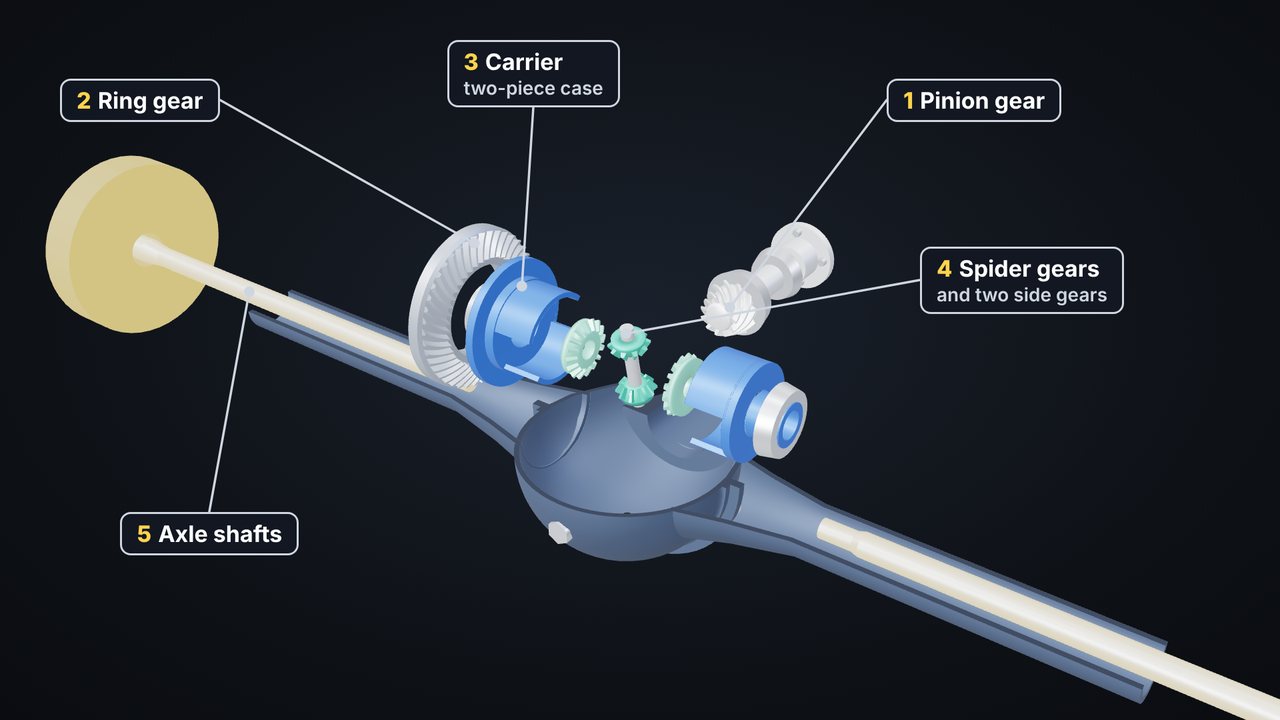
- Pinion gear. The small gear on the end of the driveshaft. It is the only way power gets into the axle.
- Ring gear. The large gear the pinion drives. This pair turns the power 90 degrees and gears it down. The pinion sits below the ring gear's center line, which makes it a hypoid gear set.[1]
- Carrier (differential case). The ring gear is bolted to it, so the carrier turns with the ring gear. It rides on a bearing at each side.
- Spider gears and side gears. Small bevel gears inside the carrier. The spider gears ride on a cross pin and mesh with one side gear on the end of each axle shaft.
- Axle shafts. One runs out to each wheel, splined into its side gear.
- Housing, fill plug and drain plug. The housing holds the oil. The fill plug sits partway up; a drain plug, where there is one, sits at the bottom. A breather on top lets pressure out as the axle warms up.[1]
The ring and pinion. The driveshaft spins the small pinion gear, and the pinion drives the large ring gear. Because the two sit at right angles, the power turns 90 degrees. Because the ring gear has more teeth, it also turns slower and with more force. In the example drawn here, a pinion with 11 teeth drives a ring gear with 43, so the driveshaft turns almost four times (43 / 11 = 3.91) for each turn of the wheels. That number is the axle ratio; yours is in the owner's manual or on the axle tag.
The carrier and the spider gears. The ring gear is bolted to the carrier, and inside the carrier the spider gears link the two axle shafts. Driving straight, both wheels turn at the same speed, so the spider gears do not rotate on their pin: the carrier, the spider gears and both shafts turn as one piece.
In a corner the outside wheel has farther to go than the inside wheel. The spider gears now rotate on their pin and let one side gear run ahead of the carrier while the other falls behind by exactly the same amount. If the carrier turns at 100%, one shaft might turn at 115% and the other at 85%: the average is always the carrier's speed. That is the whole job of the differential, and it is where the name comes from.
The math: gear ratio, wheel speeds in a turn, and how a ratio is chosen
This section works the numbers for the example axle drawn on this page: a 43-tooth ring gear, an 11-tooth pinion, 30.6 inch tires and wheels 5.25 feet apart. Your truck's numbers will differ; the formulas will not.
Gear ratio. Gear teeth cannot slip, so the same number of teeth has to pass the mesh point on both gears each second: 11 x pinion speed = 43 x ring gear speed. That gives ratio = 43 / 11 = 3.91. The pinion turns 3.91 times for each turn of the ring gear, and the torque at the ring gear is 3.91 times the torque at the pinion, less a few percent lost to friction.
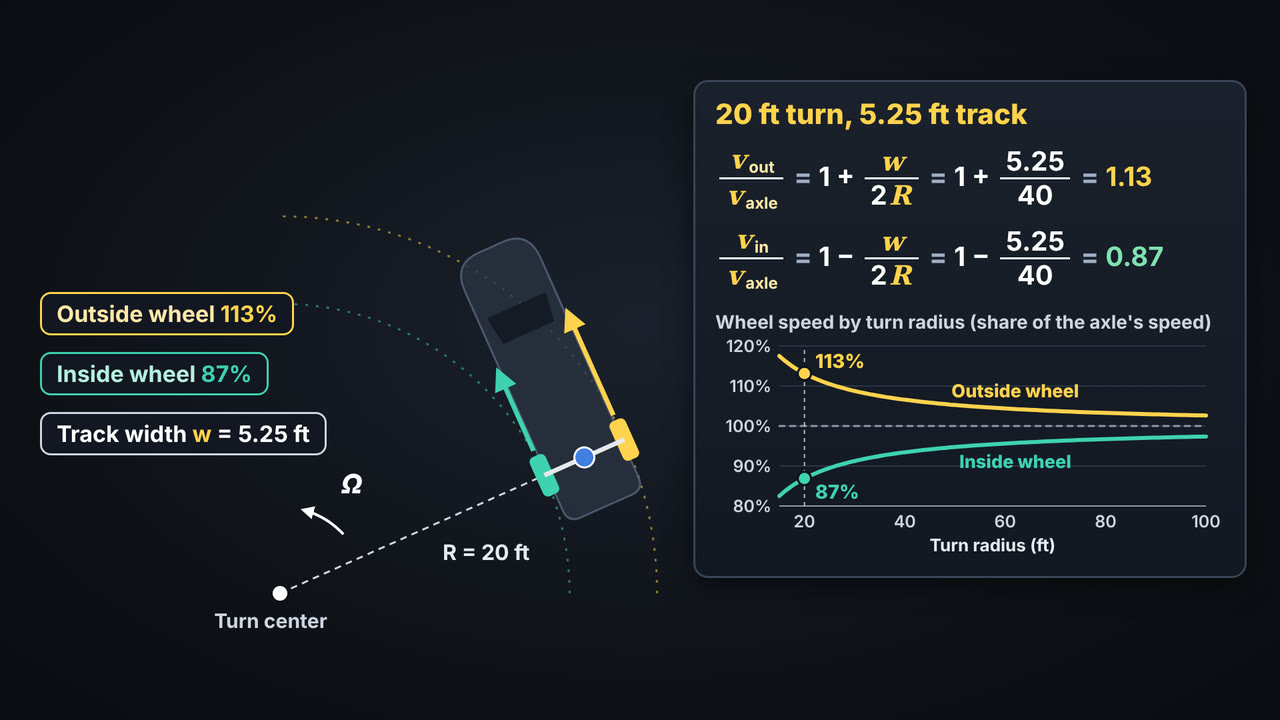
Wheel speeds in a turn. In a steady turn both rear wheels circle the same center point at the same turn rate. Speed is turn rate times radius, so the wheel on the bigger circle goes faster. If R is the radius of the turn at the middle of the axle and w is the track width (wheel to wheel), the outside wheel is on a circle of radius R + w/2 and the inside wheel on R - w/2. Divide by the speed of the middle of the axle and the turn rate cancels:
- outside wheel speed / axle speed = 1 + w / (2 x R)
- inside wheel speed / axle speed = 1 - w / (2 x R)
- On a 20 foot turn with a 5.25 foot track: 1 + 5.25 / 40 = 1.13 and 1 - 5.25 / 40 = 0.87. The outside wheel runs at 113% of the axle's speed and the inside wheel at 87%.
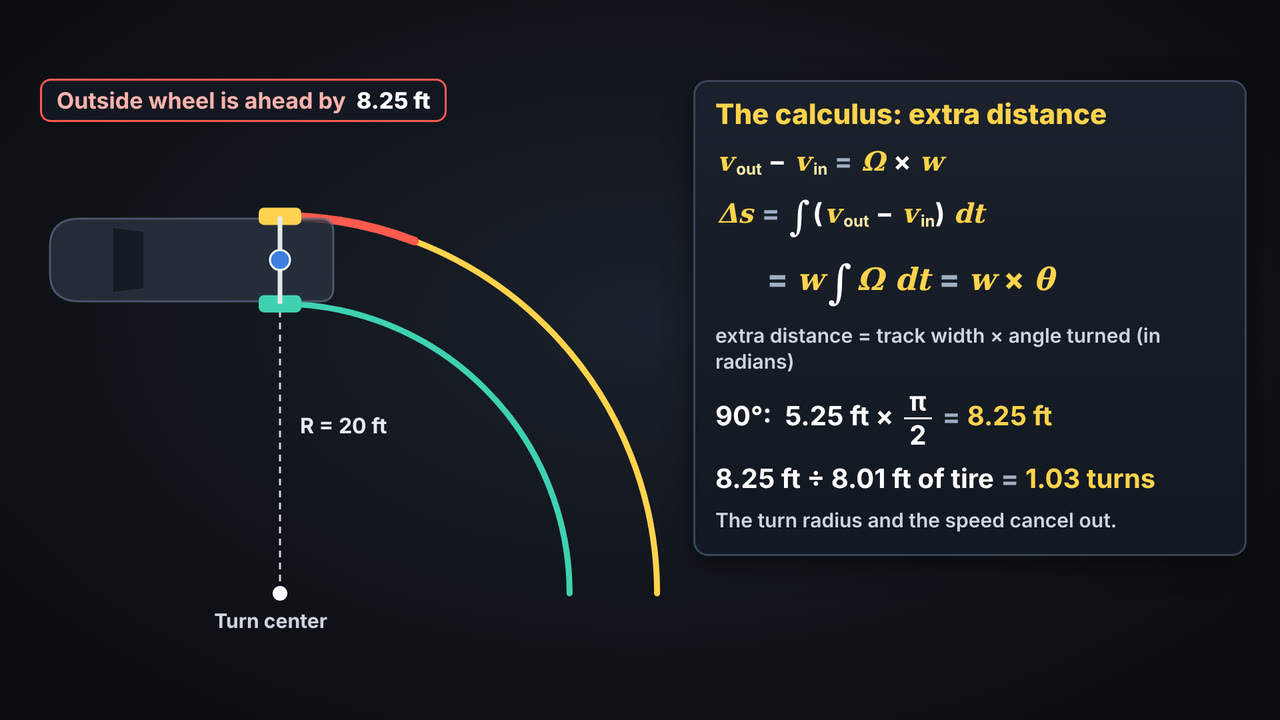
The calculus: how much farther the outside wheel goes. The speed difference between the two wheels is turn rate x w. Add that up over the time the turn takes, which is an integral: extra distance = integral of (outside speed - inside speed) dt = w x integral of (turn rate) dt. The integral of the turn rate over time is simply the angle the truck has turned through, so extra distance = w x angle, with the angle in radians. The radius of the turn and the speed both cancel out.
For a 90 degree corner the angle is pi / 2 = 1.571 radians, so the outside wheel travels 5.25 x 1.571 = 8.25 feet farther than the inside wheel. A 30.6 inch tire covers 8.01 feet per turn, so that is 1.03 extra turns of the outside tire on every right-angle corner, tight or wide, fast or slow.
What the differential does with that. The carrier always turns at the average of the two axle shafts: carrier speed = (left shaft speed + right shaft speed) / 2. One shaft runs ahead of the carrier by some amount and the other falls behind by the same amount. The spider gears turn on their pin at that amount times the tooth ratio of side gear to spider gear, here 16 / 10. With the carrier at 100 rpm on the 20 foot turn, the shafts turn at 113 and 87 rpm and the spider gears turn on their pin at about 21 rpm. Straight ahead, they do not turn at all.
How a ratio is chosen. Wheel rpm = mph x 336 / tire diameter in inches. (The 336 is 63,360 inches in a mile, divided by 60 minutes and by pi.) At 65 mph a 30.6 inch tire turns 65 x 336 / 30.6 = 714 times a minute, and the driveshaft turns 714 x 3.91 = about 2,790 rpm. The force pushing the truck is driveshaft torque x ratio / tire radius. So a numerically higher ratio gives more pull for the same torque, and a faster-turning driveshaft and engine at the same road speed. A lower ratio does the opposite. Engineers pick the ratio that balances towing and acceleration against highway engine speed and fuel use.
- 3.21 ratio: about 2,290 driveshaft rpm at 65 mph, 82% of the pull of a 3.91.
- 3.91 ratio: about 2,790 rpm.
- 4.56 ratio: about 3,260 rpm, 117% of the pull of a 3.91.
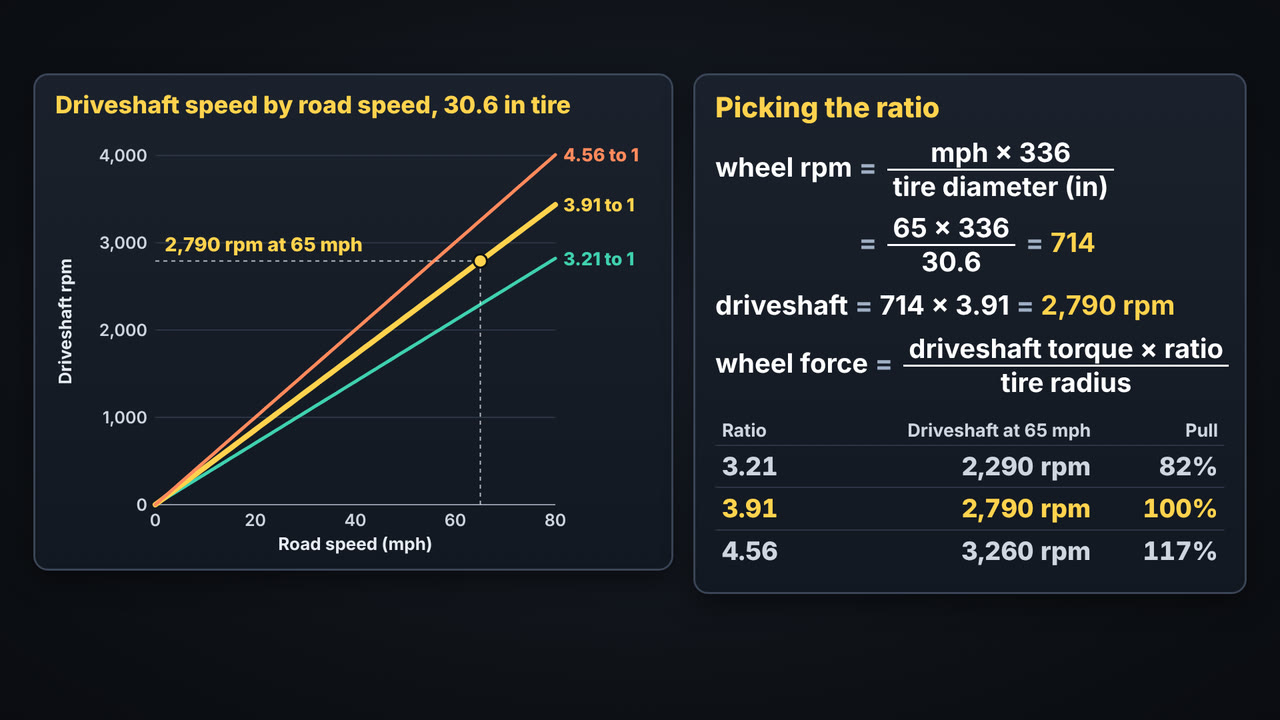
How fast the teeth slide. Because the pinion sits below the ring gear's center line, its teeth cross the ring gear's teeth at an angle, and they slide along each other as well as rolling. For a hypoid pair the sliding speed is about rolling speed x sin(offset angle) / cos(pinion spiral angle). In the example gear set drawn here the pinion is 1.26 inches below center, which makes the offset angle about 20 degrees, and the pinion spiral angle is about 49 degrees, so the teeth slide at about 0.52 times the speed they roll. At 65 mph the teeth roll past each other at about 23 feet per second and slide at about 12. Those angles are this example's, not one particular axle's, but the size of the result is why the next section is about additives.
Why gear oil has sulfur in it, and why it smells like rotten eggs
In an axle the pinion does not meet the ring gear on its center line: it sits lower. That is a hypoid gear set. It lets the driveshaft sit lower under the truck and puts more tooth in contact, but it has a cost. The teeth do not only roll across each other, as they would on the center line. They also slide, lengthwise, under very high pressure.[1]
A plain oil film gets squeezed and wiped off a contact like that. So axle gear oil carries extreme pressure (EP) additives, most often compounds of sulfur and phosphorus. Where two teeth press together hard enough to get hot, the additive reacts with the steel surface and forms a thin chemical film. That film, not the tooth, is what wears. Meritor puts it plainly for its own axles: hypoid gearing requires a GL-5 oil with EP additives.[2] [1]
The sulfur is what you smell. Gear oil smells strongly of sulfur even when it is new, and old, overheated oil smells worse. Our earlier Short covers the smell on its own: why differential oil smells like rotten eggs.[2]
The same chemistry is why axle oil does not belong everywhere. Active sulfur is corrosive to yellow metals such as brass and bronze, which some manual gearboxes and transfer cases use. An oil that protects a hypoid axle can attack those parts.[2] [4]
How differential oil breaks down
Nothing burns in an axle, so gear oil does not get dirty the way engine oil does. It wears out in other ways:
- Shear. Every pass between two gear teeth squeezes and shears the oil. Over time that can thin a multigrade oil, so its hot thickness drops.
- Heat. Towing, heavy loads and long grades heat the axle, and hot oil oxidizes: it reacts with oxygen, darkens and thickens. Meritor warns that long operation at or above 250 F may degrade the lubricant.[1]
- Additives get used up. The EP additives are consumed as they do their work, and the friction modifiers a limited-slip differential needs usually wear out sooner than the EP additives do.[1]
- Metal collects. New gears shed fine steel as they wear in, and it stays in the oil. Most axles have no filter. Many have a magnet, often on the drain plug, and that is the only thing catching it. Meritor has its magnets inspected and cleaned at each oil change.[1]
- Water. An axle that has been under water, at a boat ramp or a stream crossing, can take water in past the breather and seals. Milky oil means water, and it needs changing now.
Splash lubrication: no pump, no filter
An engine pumps its oil through a filter and into every bearing. A typical pickup axle has none of that. The oil sits in the bottom of the housing, the lower part of the ring gear runs through it, and as the gear turns it carries oil up and flings it over the pinion, the bearings and the spider gears. The oil then runs back down. That is splash lubrication.[3]
It is simple and it works, but only at the right oil level. Too low, and the gear picks up too little oil, so the gears and bearings farthest from the bath are starved. Too high has its own problems, which is why the level is set by a hole in the housing and not by guesswork.[3]
How to fill it: the drain plug, the fill plug and the right level
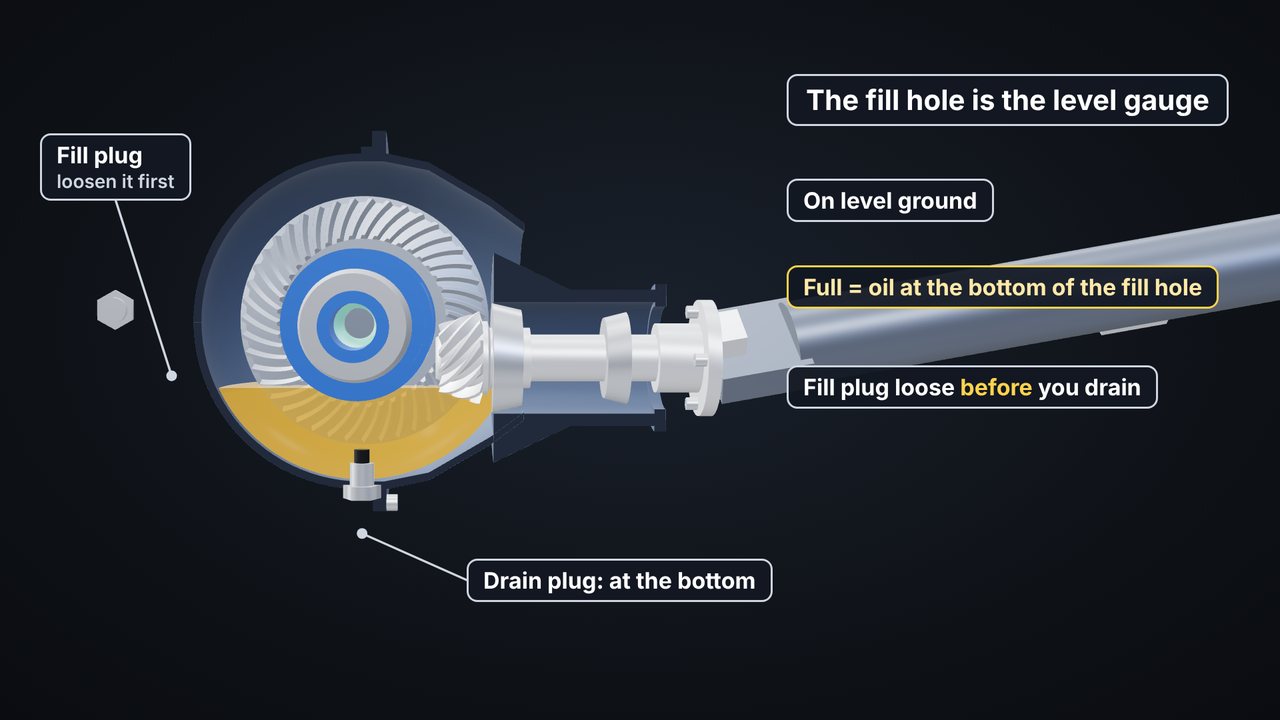
A differential has no dipstick. The housing has a fill plug partway up, on the cover or on the side of the housing, and many have a drain plug at the bottom. The fill plug is also the level gauge. Meritor's instruction for its axles is the general rule: with the vehicle level, the oil must be even with the bottom of the fill plug hole.[1]
- Park on level ground. A tilted axle gives a false level.[1]
- Loosen the fill plug first, before you drain anything. If it is seized, you want to find out while the axle still has oil in it.
- Remove the drain plug at the bottom and let the old oil run out. Some axles have no drain plug: they are emptied by removing the cover or with a suction pump through the fill hole. Wipe the metal paste off the magnet.[1]
- Refit the drain plug. Pump new oil in through the fill hole until it reaches the bottom of the hole and just starts to run back out. That is full.[1]
- Refit the fill plug and tighten both plugs to the torque in your service manual.
- A few axles are specified a set distance below the fill hole. Your service manual says which yours is.
Oil and tools (buy the grade your manual names): 75W-90 GL-5 gear oil | 75W-140 GL-5 gear oil | Limited-slip friction modifier | Gear oil fill pump
As an Amazon Associate ServiceSage Auto earns from qualifying purchases.
Why overfilling causes problems
More oil is not more protection. When the level is too high the gears run deeper in the oil and churn it. Machinery Lubrication describes what happens in an overfilled sump: the oil can be whipped full of air and foam, and aerated oil runs hotter, oxidizes faster and uses up its additives sooner. Foam also cannot hold a film between two gear teeth the way liquid oil can.[3]
The churning itself makes heat, the hot air and oil expand, and the pressure has to go somewhere: out of the breather, or past a seal. Meritor gives the same warning for its transfer cases in two places: do not overfill, because too much oil can make the case overheat, which may damage the seals.[1]
The fix is the fill hole itself. If oil is running out of it on level ground, the axle is full: let the extra drain and fit the plug.
Gear oil weights: 75W-90, 75W-140, 80W-90, and GL-4 vs GL-5
A gear oil label has two separate parts. The first is the viscosity grade, such as 75W-90. The number with the W is the cold rating (W for winter): the lower it is, the colder the oil can get and still flow. The second number is how thick the oil is at running temperature: a 140 is thicker when hot than a 90. Gear oil grades use their own scale, so a 75W-90 gear oil is in the same range of thickness as a 10W-40 engine oil, not twice as thick.
| Grade | Coldest outside temperature | What it is |
|---|---|---|
| 75W-90 | -40 F (-40 C) | The most common axle grade. Thin enough to flow in deep cold, a 90 grade once hot. |
| 75W-140 | -40 F (-40 C) | Same cold rating, but stays thicker when hot. Named for some heavy-duty and towing axles. |
| 80W-90 | -15 F (-26 C) | A 90 grade when hot, with a less severe cold rating. |
| 85W-140 | +10 F (-12 C) | Thick when hot and not rated for cold climates. |
Thicker is not automatically better. A thicker oil holds a film under heavy load and heat, but it also takes more power to churn and flows less easily in the cold. Carmakers choose the grade for the axle: Ford, for example, lists 75W-140 for the Super Duty rear axle, 80W-90 for its front axle and 75W-85 for the Expedition.[5]
The second part of the label is the API service category. GL-5 is the category for hypoid axles: it carries the most EP additive. GL-4 carries less, and is what many manual gearboxes and transaxles call for. They are not interchangeable in both directions: do not put a GL-4 oil in an axle that calls for GL-5, and do not assume a GL-5 oil is safe in a gearbox that calls for GL-4.[4] [2]
Limited-slip differentials. A clutch-type limited-slip differential needs a friction modifier so its clutches slip smoothly in a turn. Without it they stick and release, and the axle chatters or groans in tight turns. Some gear oils include the modifier and some axles need it added: Ford's Expedition, for example, takes 4 fl oz of friction modifier in a limited-slip 9.75 axle on a complete refill. The API categories do not cover this; the axle maker sets it.[1] [5] [4]
Which one to buy: Buy the grade and rating your owner's manual lists, and add a friction modifier only if it says to. Our fluid lookup shows what the manual names for the models we cover.
Transfer case fluid is usually not gear oil
The transfer case has its own oil, its own drain and fill plugs, and the same fill-to-the-hole rule. But it is a different machine: most pickup transfer cases drive the front output with a chain, and many have a clutch pack. So it usually takes a different fluid from the axles, often an automatic transmission fluid or the maker's own transfer case fluid.
From the manuals this site covers: Ford lists MERCON LV for the Expedition's transfer case, GMC lists DEXRON-VI for the Sierra 1500, and Ram lists Mopar BW44-44 fluid for the Ram 1500. Meritor goes further for its heavy-truck transfer cases and says not to install GL-5 oil in them at all.[5] [1]
So do not pour leftover axle oil into a transfer case. Look the fluid up by name.
When to change differential and transfer case fluid
It depends heavily on the truck and on how it is used. Some makers set a long interval, some only inspect, and nearly all of them shorten it for towing, off-road use or dusty roads. These are the newest model years in our data:[5]
| Model | Differential fluid | Transfer case fluid |
|---|---|---|
| Toyota Tacoma (2026) | Inspect the front (4WD) and rear differential oil every 15,000 mi; replace it every 15,000 mi only when towing. | Inspect every 30,000 mi; replace every 30,000 mi only when towing or driving on dirt or dusty roads. |
| Ford Super Duty (2025-2026) | Every 150,000 mi, front (4x4) and rear. Rear: 75W-140 synthetic. Front: 80W-90. | Every 150,000 mi; every 60,000 mi when towing (gas engines). |
| Ford Expedition (2025-2026) | Every 150,000 mi in normal duty, front and rear. 75W-85 hypoid gear lubricant. | Every 150,000 mi in normal duty; every 60,000 mi in severe duty. MERCON LV. |
| Chevrolet Silverado 1500 (2025-2026) | No scheduled change. GM says the axle fluid need not be checked unless a leak is suspected or an unusual noise is heard. | Every 100,000 mi; every 50,000 mi in severe service. |
| Ram 1500 (2026) | No routine change. Inspect the axles every 30,000 mi; change the fluid at that interval only for police, taxi, fleet, off-road or frequent towing use. | Change at 120,000 mi; at 60,000 mi for police, taxi, fleet or frequent towing use. |
| Jeep Wrangler (2026) | No routine change. Inspect at 20,000, 60,000, 100,000 and 140,000 mi; change at 40,000, 80,000 and 120,000 mi only for police, taxi, fleet, off-road or frequent towing use. | No routine change. Inspect at 30,000, 90,000 and 150,000 mi; change at 60,000 and 120,000 mi only for police, taxi, fleet or frequent towing use. |
Whatever the schedule says, change the oil after the axle has been submerged, and have a leak or a new whine or howl from the axle looked at: a low oil level is the usual cause of both.
Get a free email before your car's next scheduled service, from its factory maintenance schedule, and log each differential and transfer case fluid change with its date and mileage.
Differential fluid questions
What does a differential do?
It takes the power from the driveshaft, turns it 90 degrees to the wheels through the ring and pinion gears, and lets the two wheels on the axle turn at different speeds in a corner. The spider gears inside the carrier let one axle shaft speed up by exactly as much as the other slows down.
Why does differential oil smell like rotten eggs?
Axle gear oil carries sulfur-phosphorus extreme pressure additives. They react with the steel where the gear teeth slide under high pressure and form a film that takes the wear. The sulfur is what you smell, even in new oil.
How do I know when the differential is full?
The fill plug is the level gauge. With the vehicle on level ground, add oil through the fill hole until it reaches the bottom of the hole and starts to run back out. A few axles are specified slightly below the hole, so check your service manual.
What happens if I overfill the differential?
The gears churn the extra oil and can whip it full of air. Foamy oil runs hotter, oxidizes faster and does not hold a film as well, and the heat and pressure can push oil out of the breather or past a seal. If oil runs out of the fill hole on level ground, let it drain to the hole.
What is the difference between 75W-90 and 75W-140 gear oil?
Both have the same cold rating, 75W. The second number is the thickness at running temperature: 75W-140 stays thicker when hot than 75W-90. Some heavy-duty and towing axles call for 75W-140. Use the grade your owner's manual lists.
What is the difference between GL-4 and GL-5 gear oil?
They are API service categories. GL-5 carries the most extreme pressure additive and is the category for hypoid axles. GL-4 carries less and is what many manual gearboxes call for. The sulfur additives in GL-5 can attack the brass or bronze parts in some gearboxes, so use the category your manual names.
Does a limited-slip differential need a special oil?
A clutch-type limited-slip differential needs a friction modifier so its clutches slip smoothly. Some gear oils include it and some axles need it added. Without it the axle can chatter or groan in tight turns. Your owner's manual says whether to add one.
Is transfer case fluid the same as differential fluid?
Usually not. Many pickup transfer cases take an automatic transmission fluid or the maker's own transfer case fluid, not axle gear oil. Look it up by name before buying.
How often should differential fluid be changed?
It depends on the truck and its use. In the owner's manuals this site covers, Toyota has 2026 Tacoma owners inspect the differential oil every 15,000 miles and replace it only when towing, Ford lists 150,000 miles for the Super Duty in normal use, and GM sets no scheduled change for the Silverado 1500. Towing, off-road and dusty use shorten most intervals.
Sources
- Meritor Maintenance Manual MM-1, Lubrication (revised 08-21): drive axles and transfer cases
- Machinery Lubrication, Monitoring Active Sulfur in EP Gear Oils
- Machinery Lubrication, Why You Should Maintain Precise Oil Levels in Sumps and Reservoirs (2016)
- oilspecifications.org, API gear oil service categories (API 1560: GL-4, GL-5)
- ServiceSage Auto, What fluids does my car take? (each row is from that model year's owner's manual)