How to Perform a Coolant Flush on a Ford F-150
How the F-150 Cooling System Works
Coolant has five jobs: carry heat away, not freeze, not boil, stop corrosion, and lubricate the water pump seal. These diagrams are frames from our video. The model is the 3.5L EcoBoost, sized from published dimensions (34.6 x 17.9 in radiator core, 92.5 mm bores, 1.5 in radiator hoses); the casting shapes and hose routing are representative, not Ford drawings.
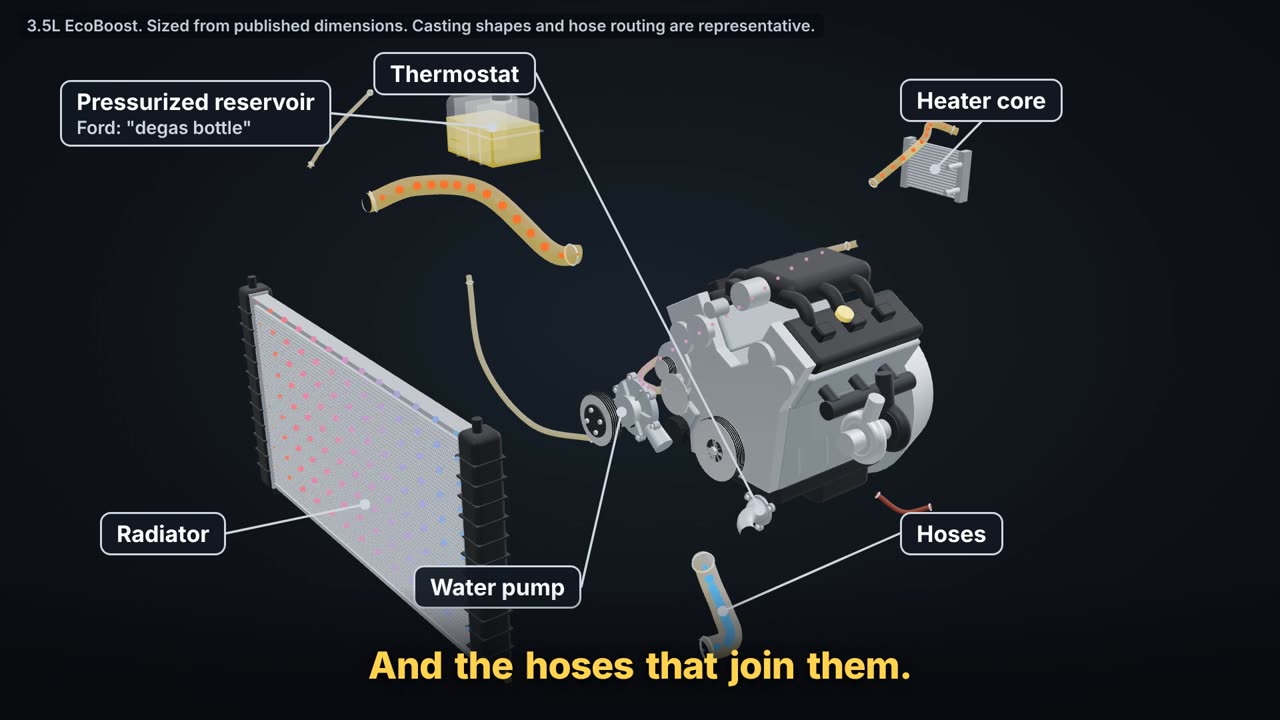
Watch how the cooling system works - 6 minutes 29 seconds: The five jobs coolant does, the parts it flows through, and why a pickup cannot just run water.
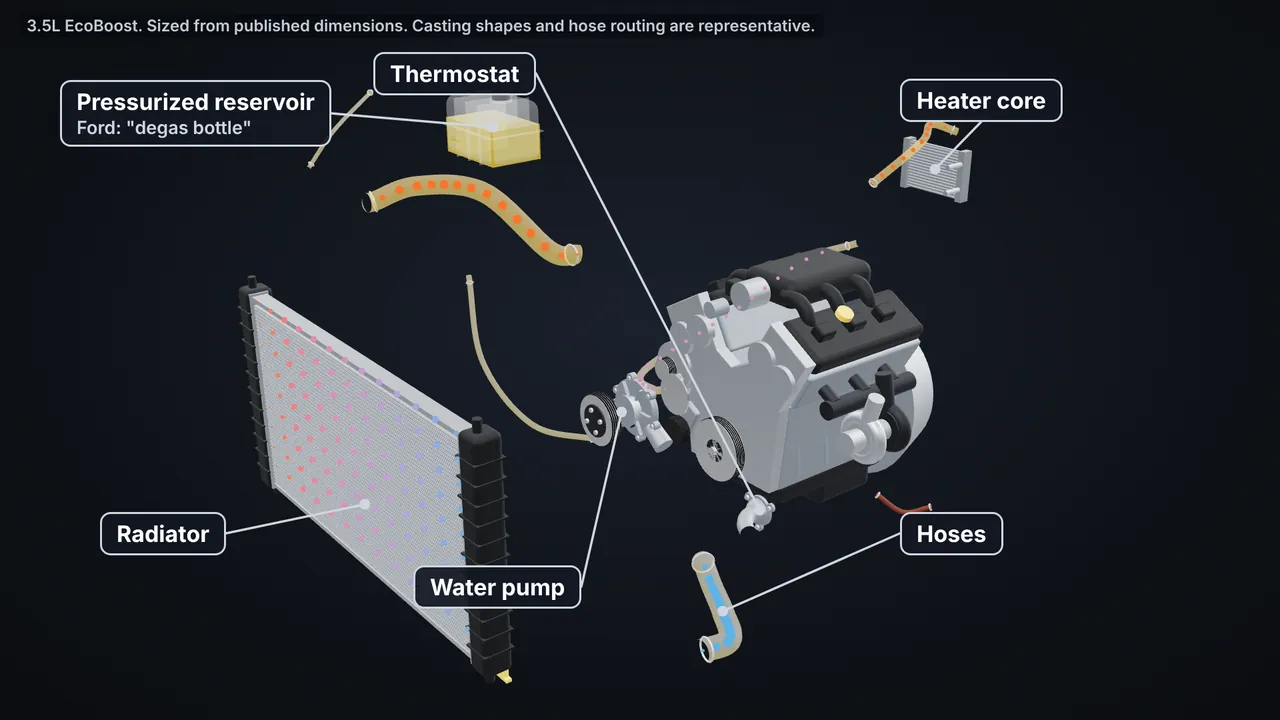
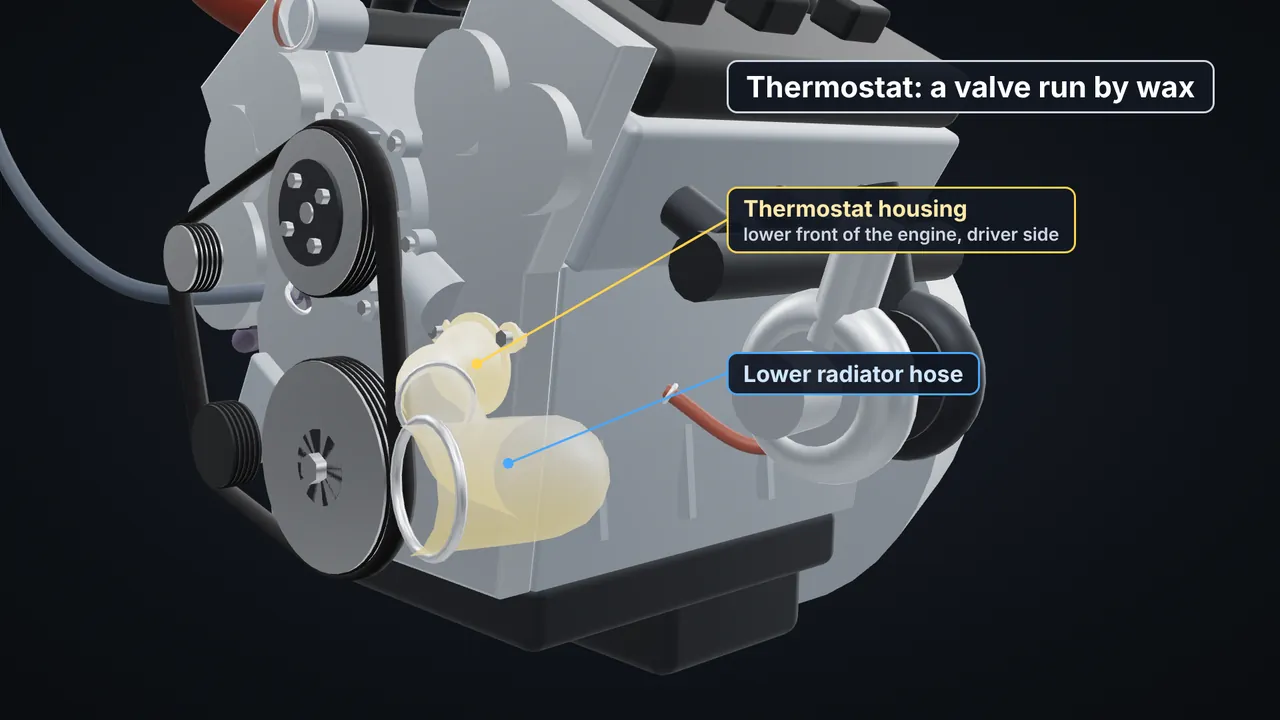
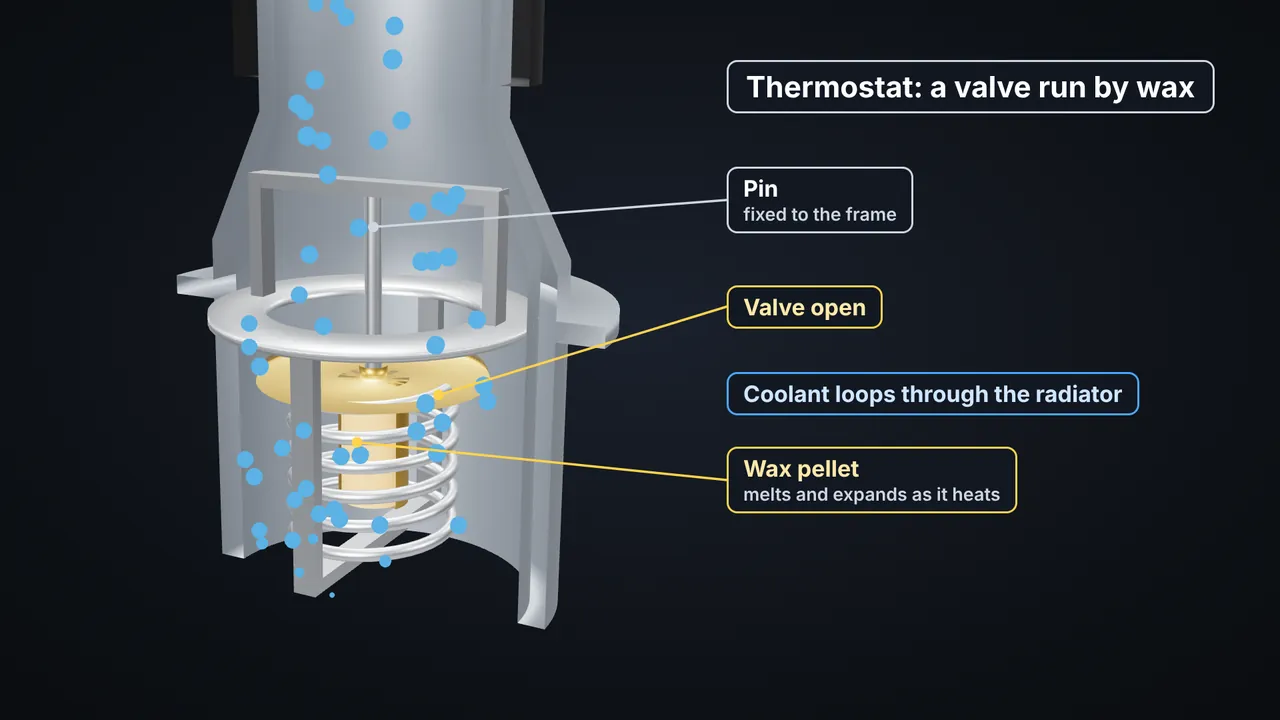
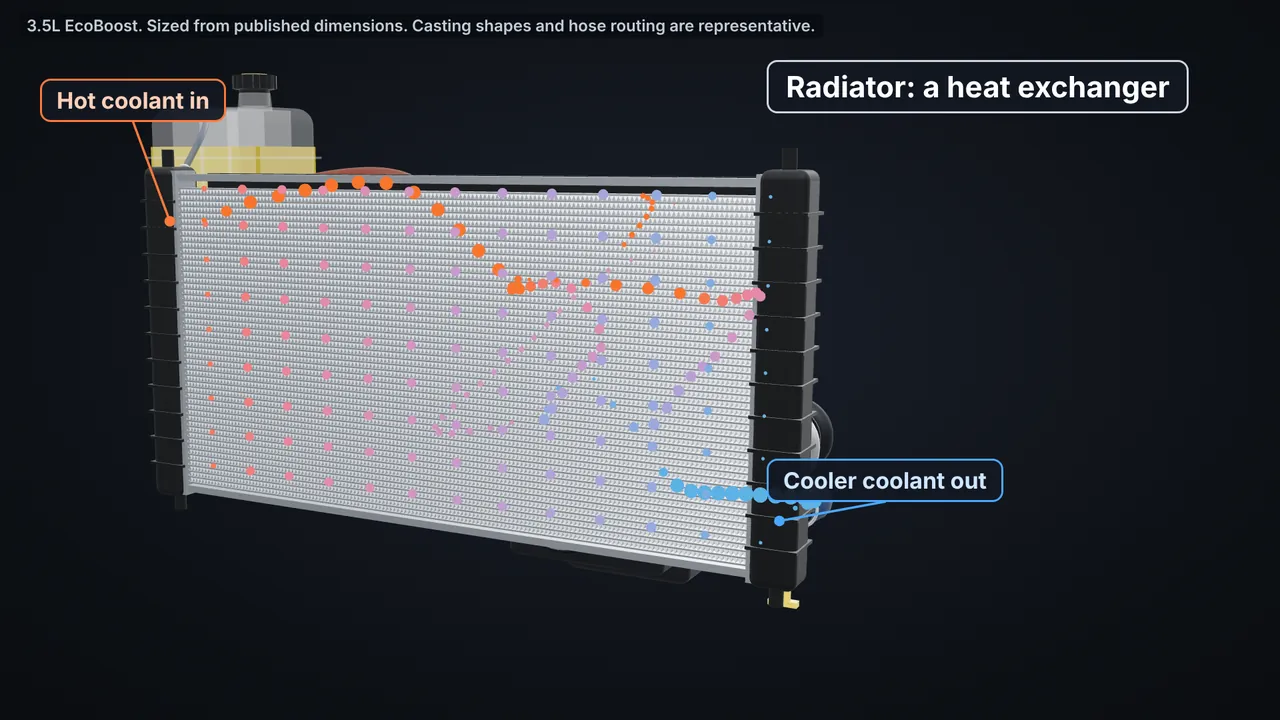
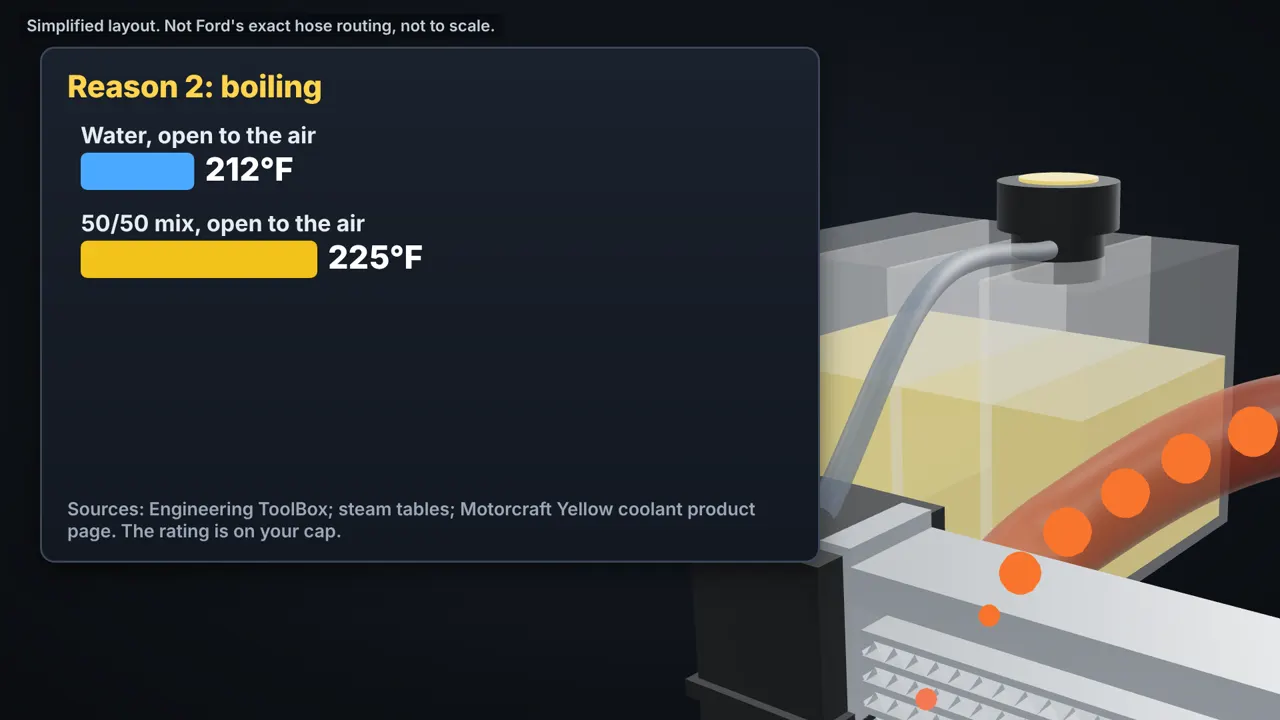
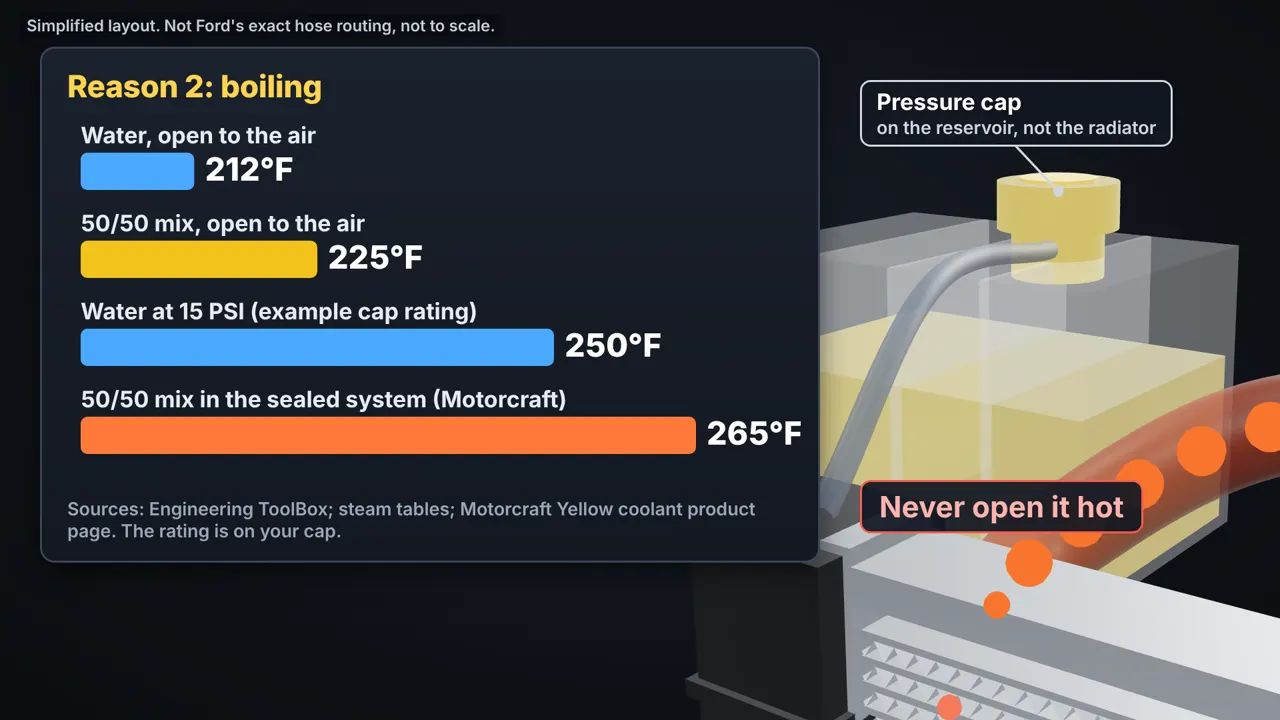
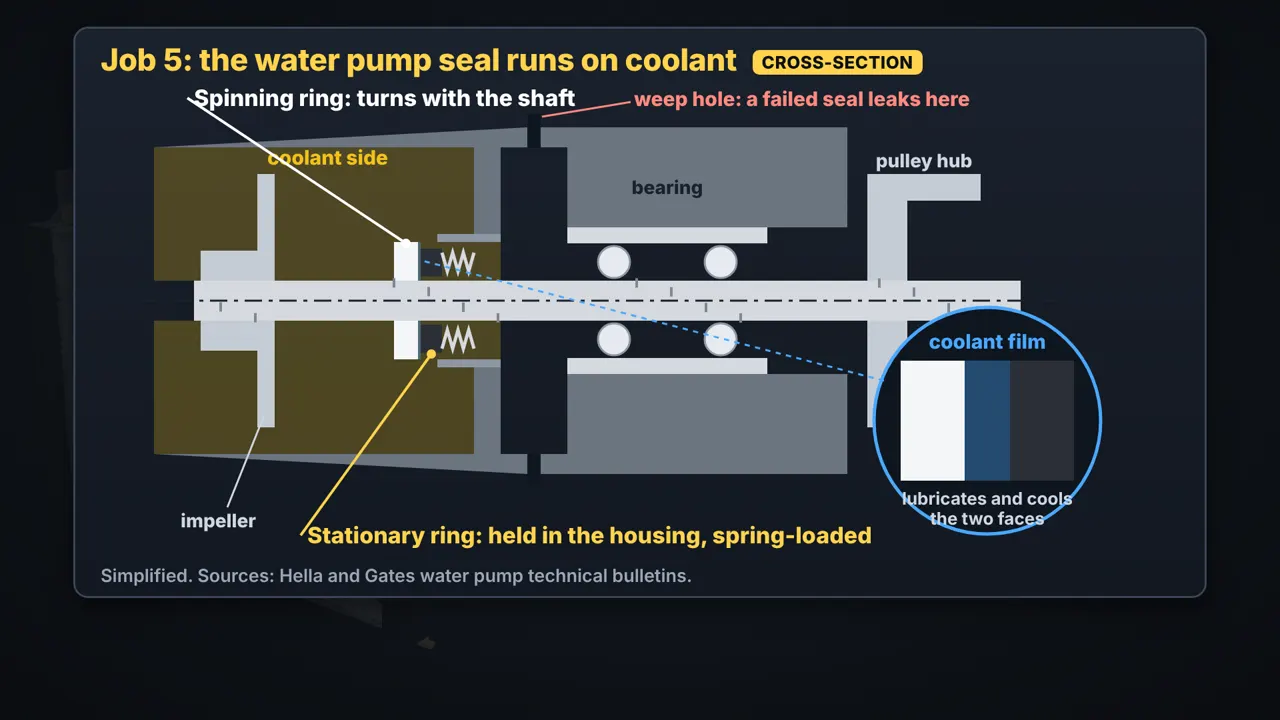
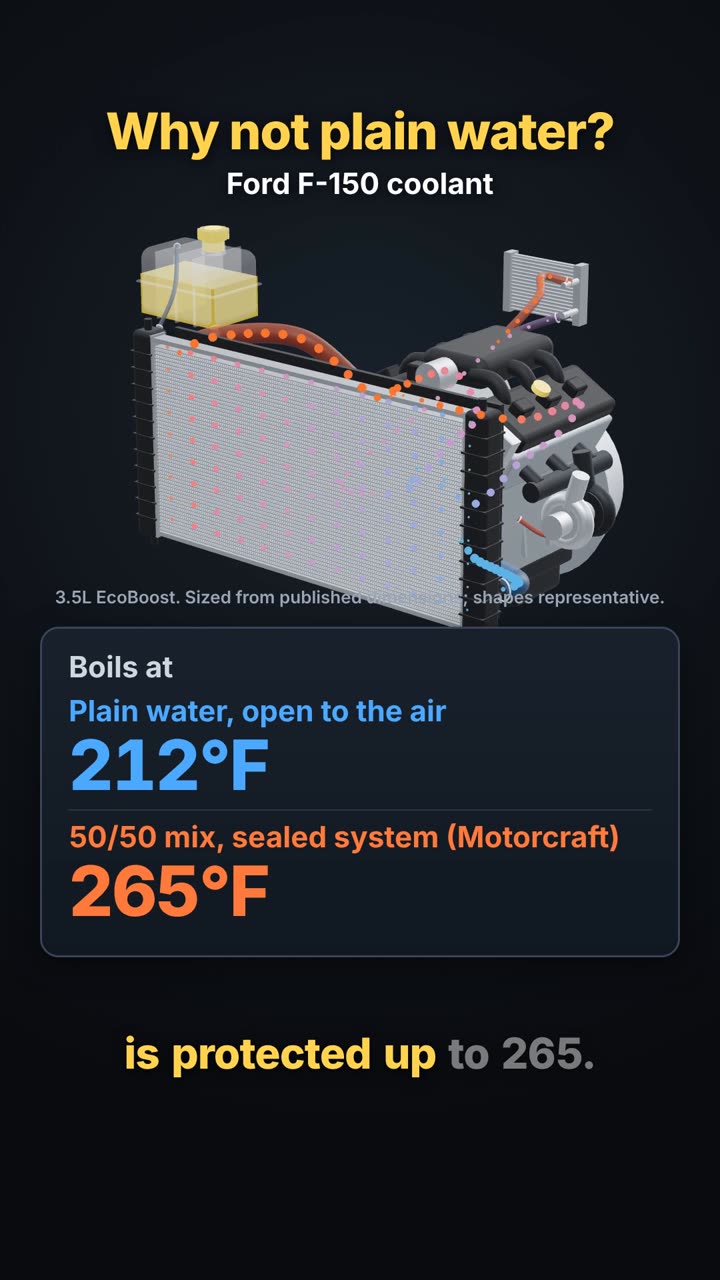
Why not plain water? - 45 seconds: Plain water boils at 212 F open to the air; a 50/50 mix in the sealed system is protected up to 265 F.
A worked example: how much coolant has to flow
Where does the heat come from? The EPA ran the F-150's 2.7L EcoBoost, the smaller sibling of the 3.5L, on an engine dyno. At a highway cruise (36 hp at 1,500 rpm) about 34% of the fuel's energy became power and about 23% left as hot exhaust; the rest, about 43%, became heat in the coolant, the oil and the metal. Under a hard pull (137 hp at 3,000 rpm) the split was 36%, 31% and 33%. The power share is the EPA's measurement; the exhaust share is our calculation from the EPA's fuel flow and turbine inlet temperature. Ford has not published a split for the 3.5L. Say an engine puts 150 hp of heat into its coolant. That is about 6,360 Btu a minute. Heat carried = flow x specific heat x temperature rise. With a 15 F rise through the engine and a specific heat of about 0.88 Btu per pound per degree F for a hot 50/50 mix, the flow works out to about 480 lb a minute, around 55 gallons a minute. Plain water (specific heat 1.0) would do the same job with about 12% less flow, but it freezes at 32 F, boils sooner and does nothing to stop corrosion. These are example figures, not a Ford specification.
Why old coolant has to come out
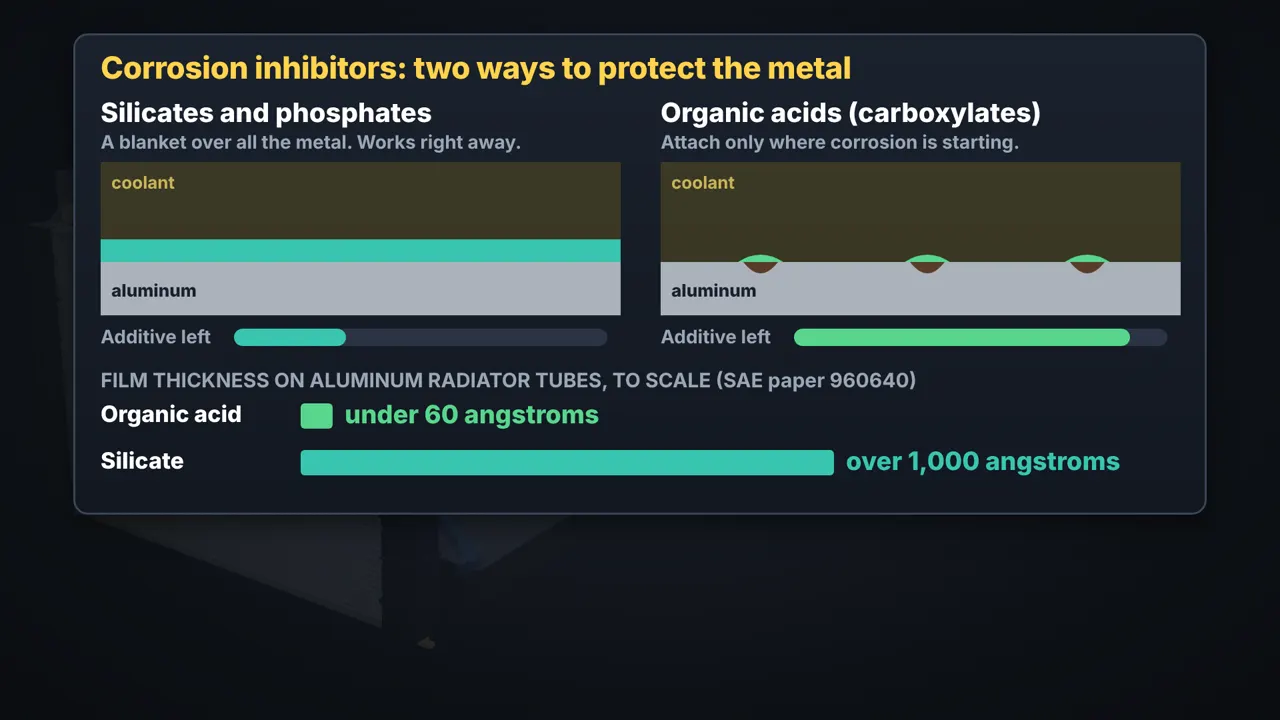
The cooling system puts aluminum, iron and steel in one hot liquid that conducts electricity, so the metals behave like a weak battery and one of them slowly dissolves (galvanic corrosion). Heat and air also break glycol down into glycolic and formic acid. A buffer in the coolant holds the pH above 7 and the inhibitors protect the metal, but both get used up. That is the reason for the change interval, and the reason Ford's manual says not to mix different colors or types of coolant. If you ever mix concentrate, use distilled water: the calcium and magnesium in hard tap water react with phosphate and leave scale on hot metal.
F-150 coolant capacity by engine
| Owner's manual | Engine | Cooling system capacity |
|---|---|---|
| 2019 | 3.5L EcoBoost | 15.2 qt (14.35 L) |
| Earlier manual* | 2.7L EcoBoost | 16.4 qt (15.5 L) |
| Earlier manual* | 3.5L V6 | 15.1 qt (14.25 L) |
| Earlier manual* | 3.5L EcoBoost | 15.6 qt (14.75 L) |
| Earlier manual* | 5.0L V8 | 15.9 qt (15.0 L) |
Source: Ford F-150 owner's manuals, Capacities and Specifications. *The manual for the 2.7L EcoBoost, 3.5L V6, 3.5L EcoBoost and 5.0L V8 lineup. Ford gives these as approximate dry-fill figures for the whole system. Draining the radiator removes only part of it; the rest stays in the block, the heater core and the hoses. Check the capacities page of your own manual.
Test the strength after a water rinse
Ford's owner's manual asks for a coolant concentration of 48% to 50% (freeze protection to -30 F to -34 F) and says to check it with a refractometer, not test strips or a hydrometer. After a distilled-water rinse, some water stays in the block and the heater core and weakens a premix refill. Test the strength after the first drive; if it reads weak, drain and refill again, or bring it up with concentrate.
Shop the supplies on Amazon
- Motorcraft Orange coolant (2018 and older)
- Motorcraft Yellow coolant (2019 and newer)
- Distilled water
- 4-gallon drain pan
- No-spill coolant funnel
- Coolant refractometer
Affiliate links - we may earn a commission.
Interval, coolant type, and capacity
Ford changed F-150 coolant with the 2019 model year. Ford's owner's manuals for 2014-2018 trucks specify Motorcraft Orange Prediluted Antifreeze/Coolant VC-3DIL-B (Ford spec WSS-M97B44-D2), first changed at 6 years or 100,000 miles and then every 3 years or 50,000 miles. From 2019 they specify Motorcraft Yellow VC-13DL-G (WSS-M97B57-A2), first changed at 10 years or 200,000 miles and then every 5 years or 100,000 miles. Both are pre-diluted - do not add water, and do not mix the two. The full cooling system holds roughly 3-4 gallons depending on engine and cab (twin-turbo EcoBoost engines hold more than the 3.3L V6); a drain-and-fill uses about 2 gallons of premix, a full flush uses 2-3 gallons plus 3-4 gallons of distilled water for the rinse.
DIY cost and procedure
A DIY flush costs about $25-$45 in fluid, versus $80-$130 at an independent shop or $130-$180 at a Ford dealership, and takes 45-60 minutes. The basic procedure: let the engine cool completely (2+ hours, since a hot pressurized cap can spray 200F+ coolant), drain the old coolant from the radiator petcock, close it and run distilled water through the system to rinse, drain again until it runs clear, refill with the Motorcraft premix your model year calls for (do not dilute), then burp the system by squeezing the upper radiator hose to release trapped air and check for leaks.
Frequently asked questions
How much does a Ford F-150 coolant flush cost?
Expect roughly $130-$180 at a Ford dealer and $80-$130 at an independent shop, or $25-$45 in coolant and distilled water if you do it yourself (our estimates). Whoever does it, make sure it is refilled with the coolant your model year calls for: Motorcraft Orange VC-3DIL-B through 2018, Motorcraft Yellow VC-13DL-G from 2019.
How often should you flush the coolant on a Ford F-150?
It depends on the model year. Ford's owner's manuals for 2014-2018 trucks (Motorcraft Orange) list the first coolant change at 6 years or 100,000 miles, then every 3 years or 50,000 miles; 2009-2013 trucks are the same generation as the 2014. From the 2019 model year (Motorcraft Yellow) the first change is at 10 years or 200,000 miles, then every 5 years or 100,000 miles. Inspect the coolant at every oil change and change it sooner if it looks rusty, muddy or has debris in it.
Is Ford F-150 coolant orange or yellow?
Both, depending on the year. Ford's manuals for 2014-2018 F-150s specify Motorcraft Orange Prediluted Antifreeze/Coolant VC-3DIL-B (Ford spec WSS-M97B44-D2); from the 2019 model year - the 2019, 2020, 2021 and 2024 manuals were checked - they specify Motorcraft Yellow Prediluted Antifreeze/Coolant VC-13DL-G (WSS-M97B57-A2). Check your owner's manual, and do not mix the two.
Can I use any orange coolant in my F-150?
No. A 2018-or-older F-150 needs Motorcraft Orange VC-3DIL-B or a coolant meeting Ford spec WSS-M97B44-D2. A 2019-or-newer truck takes Motorcraft Yellow VC-13DL-G (WSS-M97B57-A2) instead.
How much coolant does a Ford F-150 hold?
Roughly 3-4 gallons of 50/50 coolant in the full system, depending on engine and cab. The 3.5L and 2.7L EcoBoost hold more than the 3.3L V6. A drain-and-fill uses about 2 gallons of premix; a full flush uses 2-3 gallons plus distilled water for the rinse. Confirm the exact figure in your owner's manual.
Do I need to flush or just top off?
Change it at the interval - 2018 and older: first at 6 years or 100,000 miles, then every 3 years or 50,000; 2019 and newer: first at 10 years or 200,000 miles, then every 5 years or 100,000. Between changes, topping off to the line is fine, but it does not remove corrosion byproducts.
What happens if I mix coolant types?
It can form a gel-like sludge that clogs the radiator and heater core. Use only the coolant your model year specifies - Motorcraft Orange VC-3DIL-B through 2018, Motorcraft Yellow VC-13DL-G from 2019 - and never mix the two.
How do I fully drain the F-150 cooling system?
Opening the radiator petcock only drains the radiator (about half the system). To fully empty it, also disconnect the lower radiator hose and, on some engines, the block drain. Then run distilled water through the system and drain again until it runs clear before refilling with fresh Motorcraft coolant of the type your model year calls for.
How long does a coolant flush take?
About 45-60 minutes, plus 20-30 minutes if you do a second distilled-water rinse.
How do I remember when the next F-150 coolant change is due?
The first change is years away - 6 years or 100,000 miles on a 2018-or-older truck, 10 years or 200,000 miles from 2019 - and then every 3 or 5 years, far enough apart that it is easy to lose track, and nothing on the dash warns you. ServiceSage Auto (the site this guide is on) is free for up to 3 vehicles: add your F-150's year and mileage, log the flush when you do it, and it emails you before the next one is due.