Brake fluid explained: how your brakes work, DOT 3 vs DOT 4, and why it is changed at the wheels
Published . Every figure is from the federal standard, a carmaker's manual or a named trade source, linked in the sources.
The short answer
- Your brake pedal pushes a piston in the master cylinder. Brake fluid cannot be compressed, so it carries that push through the lines to a piston in the caliper at each wheel, which clamps the pads on the rotor.
- Brake fluid absorbs moisture from the air, and wet fluid boils at a lower temperature. The federal minimums: DOT 3 401 F new and 284 F wet, DOT 4 446 F new and 311 F wet.
- Nothing pumps the fluid around a loop the way engine oil is pumped, so draining and refilling the reservoir changes only the reservoir. The old fluid in the lines and calipers comes out only through the bleeder screw at each wheel.
- Honda: every 3 years, or when Maintenance Minder code 7 appears. Other carmakers set their own interval, so check your schedule.
How your brakes work: five parts and an incompressible fluid
A car's brakes are hydraulic. There is no cable from the pedal to the wheels: the push from your foot travels through brake fluid, from the master cylinder, through lines and hoses, to each corner of the car. Because the fluid cannot be compressed, pressing the pedal moves the pistons in the calipers, and the calipers clamp the pads on the rotors.[2]
What "incompressible" means here. In a liquid the molecules are already packed against each other, so pressing on it does not make it take up less room in any way you could feel. In a gas, such as air, the molecules are far apart and pushing on it packs them closer, so it shrinks. Brake fluid is a liquid sealed in a closed system, so when the master cylinder piston pushes in, the fluid cannot shrink: it has to move. That is why the pedal feels firm, and why a bubble of air or vapor in the lines, which can shrink, makes it feel soft.
Pascal's principle. A change in pressure applied to an enclosed fluid is passed on undiminished to every part of the fluid and to the walls of its container. Pressure is force divided by area, so the same pressure pushing on a bigger piston makes a bigger force. With round example numbers (not any particular car's): 100 lb on a master cylinder piston of 1 square inch makes 100 psi in the lines; a caliper piston of 4 square inches then pushes with 400 lb. The trade is distance: the small piston has to travel four times as far as the big one moves. That is how a modest push on the pedal becomes a hard clamp on the rotor.[4]

- Brake pedal. Your foot pushes a rod into the master cylinder.[2]
- Master cylinder. A piston inside it pushes on the fluid. The fluid cannot be compressed, so the push arrives at the other end of the lines almost unchanged.[2]
- Reservoir. The translucent tank on top of the master cylinder, with MIN and MAX marks. It keeps the master cylinder full; the grade of fluid is usually printed on its cap.[2]
- Lines and hoses. Steel lines run to each corner of the car and end in a short rubber hose, so the wheel can steer and move with the suspension.[2]
- Caliper at each wheel. The fluid pushes the caliper piston, which clamps the brake pads on the spinning rotor. Each caliper has a bleeder screw, usually on top.[2]
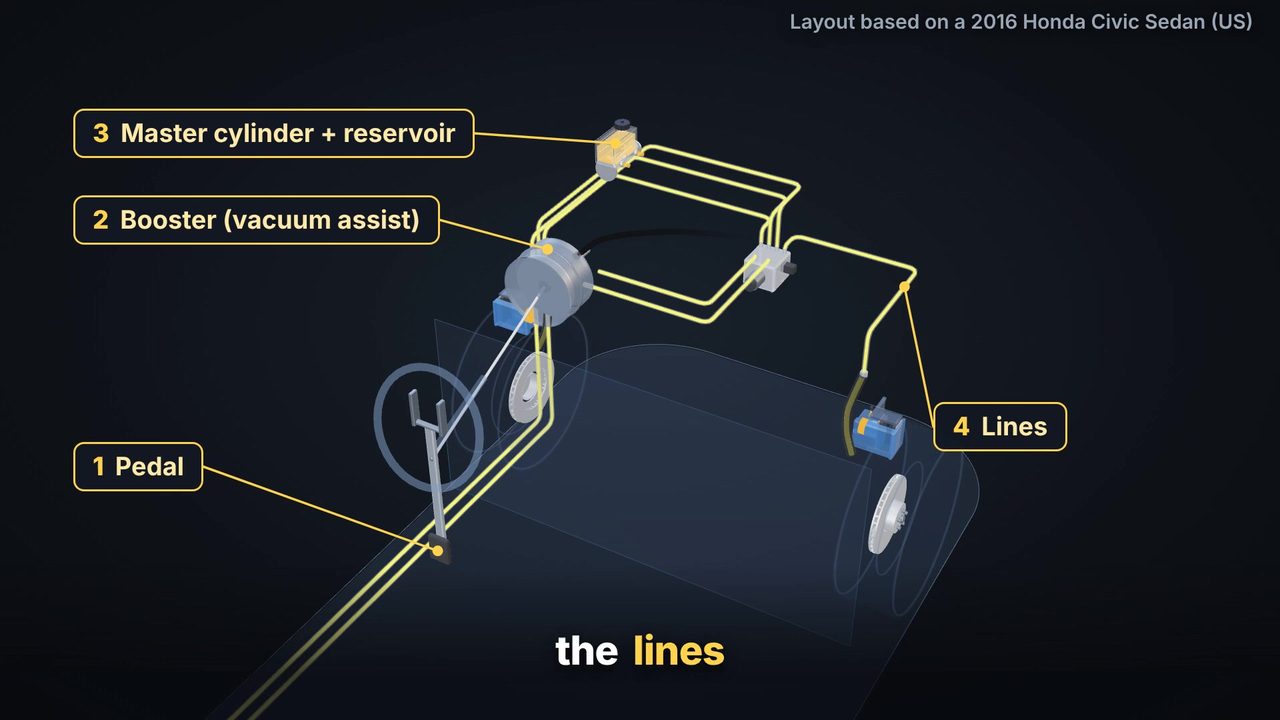
Watch the whole system work - 2 minutes 33 seconds: A true-scale view of the pedal, booster, master cylinder, ABS unit, lines and calipers, how the fluid multiplies the push from your foot, and why the old fluid comes out at the wheels.
Cars with anti-lock brakes also have an ABS unit (Honda calls it the VSA modulator) between the master cylinder and the wheels, in the engine bay (on the 2016-2021 Civic, just ahead of the master cylinder). Its valves can hold or release the pressure at each wheel, and its electronically controlled pump can apply brake pressure when ABS or traction control acts. It works only during those stops: it is not a circulation pump like the engine's oil pump.[2] [3]
Where the heat goes
Brakes stop a car by turning its speed into heat, and that heat is made at the wheels, where the pads rub the rotors. MOTOR magazine notes that most rotors can get hot enough to glow red on a long downhill stop. Brakes are built to shed it into the air through the rotors and wheels, but the caliper, and the fluid inside it, sits right next to that heat.[3]
That is why the fluid's boiling point matters. The caliper is the hottest place the fluid sits, so that is where it boils first.
DOT 3 vs DOT 4: what the boiling points mean
DOT 3 and DOT 4 are grades set by the federal brake fluid standard, FMVSS No. 116. The standard sets a minimum boiling point for new fluid and a lower one for "wet" fluid: the same fluid after it has soaked up water in a set laboratory humidity test.[1]
| Grade | New (dry) | Wet |
|---|---|---|
| DOT 3 | 401 F (205 C) | 284 F (140 C) |
| DOT 4 | 446 F (230 C) | 311 F (155 C) |
Brake fluid absorbs moisture from the air. The reservoir has to breathe: its level drops slowly as the pads wear and the caliper pistons sit further out, so air reaches the fluid through its vent and whenever the cap comes off. Bendix adds that it also gets in through microscopic pores in the rubber brake hoses, and MOTOR magazine lists an open can of fluid and a leaking wheel cylinder. MOTOR puts the effect bluntly: as little as 2% to 3% water can lower the boiling point by more than 100 F. The water also lets rust and corrosion start inside the system.[2] [5] [3]
When fluid boils it turns to vapor, and vapor, unlike liquid, can be compressed. The pedal goes soft and travels further while the pads barely move. On a long descent MOTOR describes the end result: the pedal falls to the floor and the car keeps rolling. Air left in the lines after a repair does the same, which is why a spongy pedal needs a look straight away.[3] [2]
Which one to buy: Use the grade printed on your reservoir cap or in the owner's manual. A higher DOT number is not a better fluid for every car: a car built for DOT 5 can use only DOT 5.[2]
Why brake fluid is changed at the wheels, not at the reservoir
Engine oil is pumped around a loop: it leaves the pan, goes through the filter and the engine, and drains back, so fresh oil mixes through all of it. Brake fluid has no pump and no return loop. When you press the pedal the fluid in the lines moves a short way toward the wheels, and when you let go it moves back. It never makes a trip from the calipers back to the reservoir.
So emptying the reservoir and refilling it with fresh fluid changes only what is in the reservoir. The fluid in the lines, the ABS unit and the calipers stays where it is. The only way out for that old fluid is the bleeder screw on each caliper: open it, and fresh fluid pushed in from the reservoir drives the old fluid out ahead of it. Each of the four brakes is bled on its own.[2]
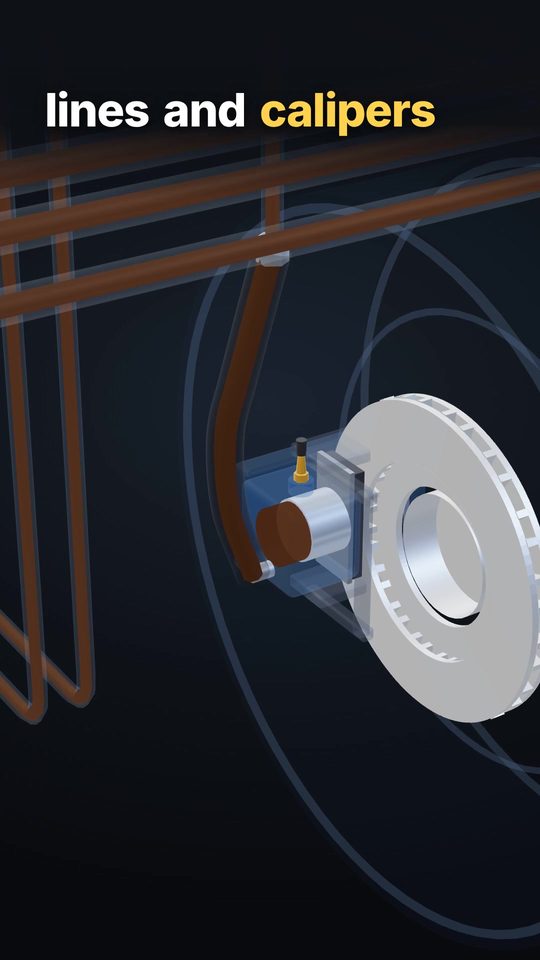
Why a top-up never reaches the calipers - 34 seconds: No pump moves brake fluid around a loop, so new fluid in the reservoir never reaches the lines and calipers.
It is not that only the fluid at the wheels goes bad. MOTOR notes that water absorbed at one wheel spreads through the whole hydraulic system within hours, so all of the fluid ages together. The point is that the fluid nearest the heat, in the calipers, is exactly the fluid a reservoir top-up never reaches.[3]
How the job is done
A shop does this with a pressure or vacuum bleeder, or two people working the pedal and the bleeder. The outline is the same either way. Check the procedure for your own car first: models differ, and some have extra bleeder screws.[2] [3]
- Take as much old fluid out of the reservoir as you can and fill it with fresh fluid of the grade on the cap, so there is less old fluid to push through.[3]
- Bleed the wheels in the order your car's service manual gives. Many procedures start at the bleeder farthest from the master cylinder, often the passenger-side rear, but the order varies by car and by ABS design.[2]
- At each wheel, run fluid out through a clear hose into a container until it comes out clean. Once clean fluid shows at the far end, that line has been changed.[3]
- Working alone, gravity bleeding works: fill the reservoir near the top, open one bleeder at a time and let gravity push the fluid through, without touching the pedal. It is slow, so keep topping up.[2]
- Some newer cars, including many hybrids, use an electric brake-by-wire system that needs a diagnostic tool to change the fluid.[2]
- Brake fluid irritates skin, can damage eyes and strips paint: wear gloves and glasses, and keep water handy to rinse any paint it touches.[2]
Fluid and tools (buy the grade your cap names): DOT 3 brake fluid | DOT 4 brake fluid | One-person brake bleeder kit
As an Amazon Associate ServiceSage Auto earns from qualifying purchases.
Cars with ABS, and Honda's own procedure
Almost every car on the road now has ABS. The job is the same in outline, but a few things matter more, from MOTOR magazine and general service practice:
- Never let the reservoir run low. If the master cylinder draws air into the lines, and above all into the ABS unit, the job gets much harder: a bubble behind an ABS valve may need the carmaker's scan tool to cycle the unit, which can make it a dealer job.[3]
- A normal bleed changes the fluid in the lines and calipers. Passages inside the ABS unit that only open when it acts may need that scan-tool cycle as well; the service manual says when.[3]
- When new pads go on, open the bleeder before pushing the caliper piston back, and catch the fluid. Forcing it back with the bleeder shut sends the dirtiest fluid from the caliper back up through the ABS unit to the master cylinder, where grit can lodge in a valve.[3]
- Use the fluid your manual or reservoir cap names, and never put DOT 5 (a silicone-based fluid) in a car that calls for DOT 3 or DOT 4.[1] [2]
Honda's procedure for the 2016 Civic sedan (its service manual, paraphrased) shows how a carmaker spells this out. The preferred method is two people: a clear tube from the bleed screw into a catch bottle with fluid in it, the helper pumping the pedal and then holding it down while the screw is opened and closed, repeated at each wheel until the fluid in the tube is fresh and free of bubbles. The reservoir starts at the MAX line and is checked and topped up after every wheel. Honda warns against pumping the pedal with a pressure bleeder connected, because the extra pressure can damage the master cylinder. And because air can be trapped inside the electric parking brake calipers, if the reservoir ran empty or the master cylinder, a rear caliper, a rear hose or line, or the VSA modulator was removed, the brakes are bled normally, the parking brake is applied and released five times, and the rear brakes are bled again. The wheel order is printed in the manual's own sequence diagram: follow it.[6]
When to change it: Honda's 3-year rule and Minder code 7
Honda says to replace the brake fluid every 3 years. On a car with the Maintenance Minder it shows as sub-code 7, and Honda adds that if no 7 has appeared within 36 months of the last reset, the fluid should still be changed at 3 years. So a 7 can arrive paired with an oil service: A7, B7, A17. The Maintenance Minder code guide decodes every combination.[7]
| Carmaker | Brake fluid |
|---|---|
| Honda (2022 Civic) | Every 3 years; Maintenance Minder sub-code 7, and at 36 months even if no 7 has appeared.[7] |
| Toyota (2024 Corolla) | Brake fluid level and condition are inspected at routine visits; the guide prints no replacement interval.[8] |
| Chevrolet (2020 Silverado 1500) | Every 5 years.[9] |
Whatever the interval, the brakes also need bleeding whenever the system is opened, such as a new caliper, hose or master cylinder, because air gets in. And brake fluid has to be changed through the bleeders, so ask for a brake fluid change or flush by name: an oil service or a reservoir top-up does not do it.[2]
Get a free email before your car's next scheduled service, from its factory maintenance schedule, and log each brake fluid change with its date and mileage.
Brake fluid questions
Is brake fluid incompressible?
For practical purposes, yes. Its molecules are already packed together, so pushing on it does not shrink it; it moves instead. By Pascal's principle the pressure from the master cylinder reaches every caliper undiminished, and a larger caliper piston turns that pressure into a larger force. Air or vapor in the lines can be compressed, which is why it makes the pedal soft.
Does topping up or replacing the brake fluid in the reservoir change the fluid?
No. Brake fluid has no pump and no return loop, so fresh fluid in the reservoir does not mix through the lines and calipers. The old fluid in them comes out only when it is pushed out through the bleeder screw at each wheel.
What is the difference between DOT 3 and DOT 4 brake fluid?
The boiling points. Under the federal standard FMVSS No. 116, DOT 3 must boil no lower than 401 F new and 284 F after absorbing water; DOT 4 must reach 446 F new and 311 F wet. Use the grade printed on your reservoir cap or in the owner's manual.
Why does old brake fluid make the brake pedal soft?
Brake fluid absorbs water from the air, and wet fluid boils at a lower temperature. When it boils in a hot caliper it turns to vapor, which can be compressed, so the pedal travels further and the brakes do less. Air left in the lines after a repair does the same.
In what order should brakes be bled?
In the order your car's service manual gives. Many procedures start at the bleeder farthest from the master cylinder, often the passenger-side rear, and work closer, but the order depends on the car and its ABS, so follow the manual.
Is bleeding the brakes different on a car with ABS?
The outline is the same, but never let the reservoir run low: air drawn into the ABS unit may need the carmaker's scan tool to clear. Open the bleeder before pushing caliper pistons back for new pads, and use the fluid your manual names. Some cars, such as the 2016 Honda Civic with its electric parking brake, also need an extra step that the service manual describes.
How often should brake fluid be changed?
It depends on the carmaker. Honda says every 3 years, shown as Maintenance Minder code 7. Chevrolet's 2020 Silverado 1500 manual says every 5 years, and Toyota's 2024 Corolla guide inspects the fluid rather than setting an interval. Your own schedule has the answer for your car.
What does the 7 mean in a Honda Maintenance Minder code?
Replace the brake fluid. It can show on its own or with an oil service, as in A7, B7 or A17, and Honda says to change the fluid at 3 years even if no 7 has appeared.
Sources
- 49 CFR 571.116, FMVSS No. 116 Motor vehicle brake fluids, S5.1.1 and S5.1.2 (Cornell LII)
- RepairPal, How to Bleed Your Brakes, and Why It's Important (2018)
- MOTOR magazine, Bursting the Bubble (brake bleeding)
- OpenStax, College Physics 2e, 11.5 Pascal's Principle
- Bendix, Bendix's tips for brake fluid change and bleeding using a brake bleeder kit
- Honda Service Information, 2016 Civic Sedan: Conventional Brake System Bleeding (Except Type-R) (subscription)
- Honda 2022 Civic Sedan owner's manual (Maintenance Minder section)
- Toyota 2024 Corolla Warranty & Maintenance Guide
- Chevrolet 2020 Silverado 1500 owner's manual (Maintenance Schedule)