Kubota BX23S 50-hour service: what the manual says to do
Published . Every figure is from Kubota's operator's manual for the BX23S, LA340 loader and BT603 backhoe (code K2892-7122-3), with the printed page beside it. If your manual is a different edition, its chart governs.
The short answer
- Three jobs, done once, at 50 hours: change the engine oil, replace the engine oil filter and replace the HST oil filter. Kubota's chart marks them with a double circle and says you must do them (pp. 117-118).
- Five checks that come back every 50 hours: the engine start system, the operator presence control (OPC), grease at 7 points, wheel bolt torque, and cleaning the lock lever if your tractor has one (p. 117).
- With the loader and backhoe on: check the torque of the loader main frame bolts and the backhoe sub frame bolts every 50 hours too. Their grease fittings are a 10-hour job, not a 50-hour one, and the loader mounting bolts get one re-tightening at 20 to 30 hours (pp. 144, 146).
- The transmission fluid is not changed. Only the HST filter is replaced and the level topped up with Kubota Super UDT-2. The fluid itself is a 400-hour job (pp. 117, 134-135).
- The next oil change is at 200 hours on the meter, not 250. The chart's marks are at 200, 400 and 600 (p. 117).
What is due at 50 hours
Kubota's service chart for the BX23S has a column for every 50 hours on the hour meter. Two kinds of mark sit in the 50-hour column: a double circle on three rows, which is a first service done once, and a single circle on five rows, which comes back every 50 hours for the life of the tractor.[1]
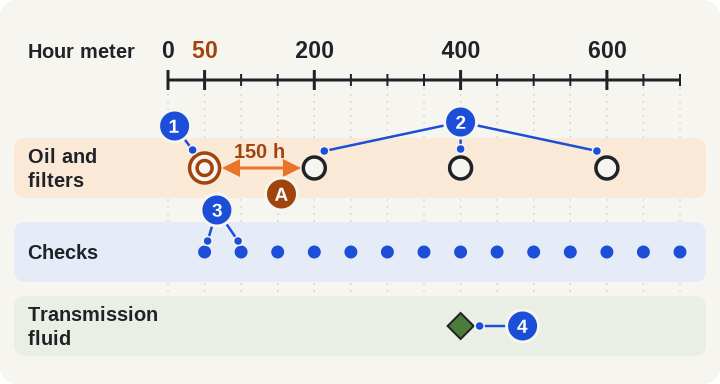
- 1. Double circle at 50: the one-time first service. "You must perform the jobs indicated by" the double circle "after the first 50 hours of operation" (p. 118).[1]
- 2. Circles at 200, 400 and 600: the same three jobs, every 200 hours.[1]
- 3. A dot every 50 hours: the five repeating checks.[1]
- 4. Diamond at 400: the first transmission fluid change. Nothing in that row at 50 hours.[1]
- A. 150 hours from the first service to the next oil change. The chart has no mark at 250.[1]
| Job | At the first 50 hours | After that | Manual page |
|---|---|---|---|
| Engine oil | Change (one-time first service) | Every 200 hours: at 200, 400, 600 on the meter | 117, 133-134[1] |
| Engine oil filter | Replace (one-time first service) | Every 200 hours: at 200, 400, 600 | 117, 133[1] |
| HST oil filter | Replace (one-time first service) | Every 200 hours: at 200, 400, 600 | 117, 134[1] |
| Engine start system | Check | Every 50 hours | 117, 127[1] |
| OPC (operator presence control) system | Check | Every 50 hours | 117, 128[1] |
| Greasing, 7 points on the tractor | Grease | Every 50 hours, more often in wet and muddy work | 117, 119, 126-127[1] |
| Wheel bolt torque | Check | Every 50 hours | 117, 128-129[1] |
| Lock lever (if equipped) | Clean | Every 50 hours | 117, 129[1] |
| Loader main frame bolts and nuts (LA340) | Check torque | Every 50 hours | 144[1] |
| Backhoe sub frame bolts (BT603) | Check torque | Every 50 hours | 146[1] |
At the tractor, in order:
- Read before you start: engine off and cool, key out, level ground.
- Drain the engine oil, change the oil filter, refill to the upper notch.
- Change the HST oil filter and top up the transmission fluid.
- Grease the 7 points on the tractor.
- Check the wheel bolts, and the loader and backhoe frame bolts, with a torque wrench.
- Clean the lock lever area, if your tractor has one.
- Last, once the oil is back in: run the two safety tests, engine start and OPC.
- Write down the date and the hours.
None of these jobs carries the manual's "consult your local Kubota dealer for this service" mark, so the manual treats all of them as jobs an owner can do. A dealer will do them too.[1]
Before you start
Safety: Kubota's warnings for these jobs: stop the engine and remove the key, and let the engine cool down, because "oil can be hot and can burn" (p. 133). Park on firm, flat, level ground with the parking brake set and the implements lowered. Never work under anything held up only by hydraulics; if you must go under the tractor, support it with stands or blocking first (p. 122).[1]
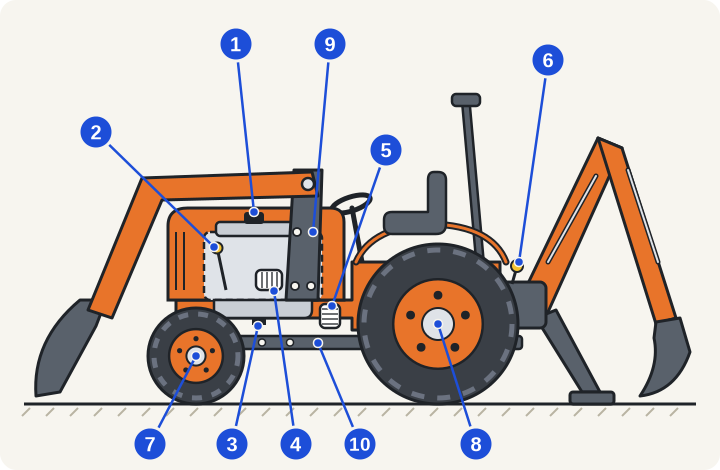
- 1. Engine oil inlet (filler cap), on top of the engine under the hood. New oil goes in here (pp. 123, 134).[1]
- 2. Engine oil dipstick, lower on the side of the engine. Two notches: the level is right anywhere between them (pp. 123, 134).[1]
- 3. Engine oil drain plug, one plug "at the bottom of the engine" (p. 134).[1]
- 4. Engine oil filter, a spin-on filter low on the engine block (p. 133).[1]
- 5. HST oil filter, a second spin-on filter. The manual shows it only in a close-up photo on the transmission case and names no side (p. 134).[1]
- 6. Transmission oil inlet and dipstick, one combined part at the rear of the tractor, between the three-point links. Top up here after the HST filter (p. 124).[1]
- 7. Front wheel bolts: 110 to 132 lbf-ft (149 to 179 N-m) (p. 129).[1]
- 8. Rear wheel bolts: 80 to 96 lbf-ft (109 to 130 N-m) (p. 129).[1]
- 9. Loader main frame bolts and nuts, on the loader's main frame beside the tractor: 108 lbf-ft (147 N-m) for the set the manual's picture numbers (1), 150 lbf-ft (203 N-m) for set (2). The picture on page 144 shows which is which.[1]
- 10. Backhoe sub frame bolts, low on the side of the tractor, on the sub frame: 108 lbf-ft (147 N-m) (p. 146).[1]
Still under 50 hours? The break-in page's main rule until then: "Do not operate the tractor at full speed for the first 50 hours" (p. 64).[1]
What the manual does not print. It gives no part number for either filter, no torque for the drain plug, no wrench sizes and no list of tools. It also does not tell you to warm the engine before draining; its only temperature instruction is to let the engine cool. Where this page says "the manual prints nothing", that is exactly what we found, and the right source for the missing figure is your Kubota dealer with the tractor's serial number.[1]
Jobs 1 and 2: engine oil and oil filter, in the order to do them
Kubota prints the filter steps (p. 133) and the oil steps (p. 134) as two separate lists. Here they are as one sequence, drain first, so the filter comes off an empty engine. We combined the two lists; anything marked "ours" is our advice.[1]
- Drain. Remove the drain plug at the bottom of the engine and drain the oil completely into a pan.[1]
- Old filter off. Remove the engine oil filter.[1]
- Oil the new seal. Put a film of clean engine oil on the rubber seal of the new filter.[1]
- New filter on. Spin it on until the seal contacts the mounting surface, then tighten it by hand an additional 1/2 turn only.[1]
- Plug in. Reinstall the drain plug. The manual prints no torque for it. (Ours: tighten it firmly and look for drips after the first run.)[1]
- Fill. Pour new oil in through the oil inlet on top of the engine, up to the upper notch on the dipstick.[1]
- Check. On level ground, pull the dipstick, wipe it, push it back in and pull it again: the oil must sit between the two notches (p. 123). With the BT603 backhoe on, the manual wants the tractor, loader and backhoe on a flat surface and set as its picture shows before you read the level: loader bucket flat on the ground, backhoe folded in (p. 123). A new filter takes a little oil, so the manual tells you to check the level again and to make sure no oil leaks past the filter seal (p. 133).[1]
- Dispose of the used oil properly. (Ours: the old filter goes with it.)[1]
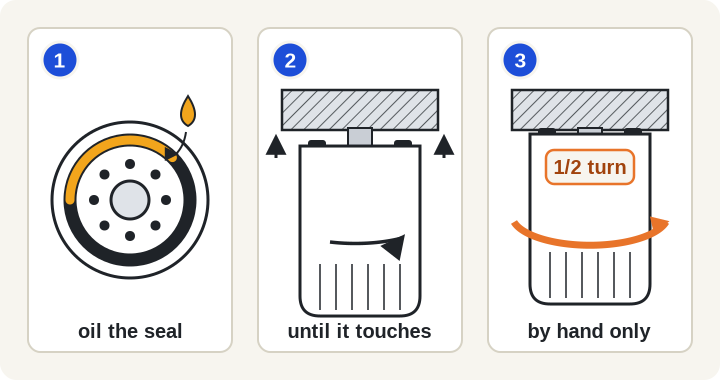
- 1. A film of clean oil on the rubber seal of the new filter: engine oil for the engine filter, transmission oil for the HST filter (pp. 133-134).[1]
- 2. Spin it on until the seal contacts the mounting surface. Kubota: "Tighten the filter quickly until it contacts the mounting surface" (p. 133).[1]
- 3. Then half a turn more, by hand. Kubota: "Tighten filter by hand an additional 1/2 turn only" (p. 133). No wrench for this step.[1]
Two practical notes that are ours, not the manual's: keep the drain pan under each filter as it comes off, because both hold fluid, and wipe the mounting surface clean before the new filter goes on.
From the manual: "To prevent serious damage to the engine, use only a KUBOTA genuine filter" (p. 133). The manual gives no part number, so buy by model and serial number.[1]
How much oil. The manual prints two figures. The lubricants table says 3.3 L (3.3 U.S. qts.), measured with the level at the dipstick's upper mark (p. 119). The oil-change page says "oil capacity with filter 3.1 L (3.3 U.S.qts.)" (p. 134). Both pages agree on 3.3 U.S. quarts and both tell you to fill to the upper notch, so the dipstick, not the number, is the target. (Ours: buy 4 quarts, pour in about 3, then add a little at a time.)[1]
When to read the dipstick. The BX23S manual says to check the oil "before starting the engine or five or more after the engine has stopped" (p. 123); the unit is missing in the original. Kubota's LX2610 manual prints the same sentence with the unit: "5 minutes or more after the engine has stopped".[1] [2]
Which grade. Pick it by the air temperature you work in. SAE10W-30 and 15W-40 are listed for every range:[1]
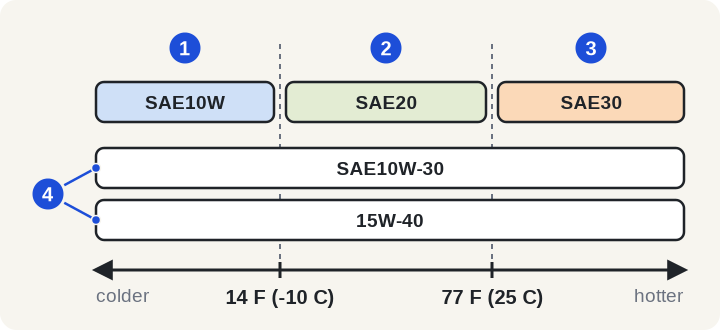
- 1. Below 14 F (-10 C): SAE10W, or a multigrade.[1]
- 2. 14 F to 77 F (-10 C to 25 C): SAE20, or a multigrade.[1]
- 3. Above 77 F (25 C): SAE30, or a multigrade.[1]
- 4. SAE10W-30 or 15W-40 appear in all three ranges, so either one covers the year (p. 119).[1]
Which API class. With today's ultra low sulfur diesel, the manual lists API CF, CF-4, CG-4, CH-4 or CI-4 for the BX23S, and adds: "The CJ-4 engine oil is intended for DPF (diesel-particulate-filter) type engines, and cannot be used on this tractor" (p. 119).[1]
Our reading: At the store, turn the bottle over and read the API line. A bottle that names CI-4 (or CH-4, CG-4, CF-4, CF) and does not name CJ-4 is the clear match to this manual. Many current diesel oils list several classes at once, CI-4 next to CJ-4 or the newer CK-4. This manual does not say whether such a bottle is acceptable, and we found no Kubota document that settles it, so we will not tell you it is. For those bottles, ask a Kubota dealer or buy the oil the dealer stocks for the BX series.
One more rule from the daily-check page: when you switch to a different maker or viscosity, drain all of the old oil and change the filter. "Never mix two different types of engine oil" (p. 123).[1]
Job 3: HST oil filter
The HST (hydrostatic transmission) filter is a second spin-on filter; the photo on page 134 shows it on the transmission case. It goes on exactly like the engine filter, with transmission oil on the seal instead of engine oil.[1]
- Remove the HST oil filter.[1]
- Put a film of clean transmission oil on the rubber seal of the new filter.[1]
- Spin it on until the seal contacts the mounting surface, then tighten by hand an additional 1/2 turn only.[1]
- Check the transmission fluid level: the manual says it "will decrease a little". Pull the dipstick at the rear of the tractor, wipe it, reinsert it and pull it again. The level must be between the 2 notches (p. 124).[1]
- Top up through the same opening with Kubota Super UDT-2 fluid, and check that the new filter does not leak. The manual also says: "If the transmission-fluid-level is low, do not run the engine" (p. 124).[1]
From the manual: You are not changing the transmission fluid here. The chart's "Transmission fluid, change" row has its first mark at 400 hours (p. 117). The case holds 11.3 L (3.0 U.S. gals.) (p. 119), but a filter change needs only a top-up; the manual does not print how much. It names Kubota Super UDT-2 and says regular UDT is also permitted (pp. 119-120).[1]
The footnote that confuses people
Beside the three double-circle rows the chart has a footnote: "The initial 50 hours should not be a replacement (changing) cycle" (p. 118). Read alone, it sounds like "do not change the oil at 50 hours". It does not mean skip it.[1]
The IMPORTANT note above it says you must do the double-circle jobs after the first 50 hours (p. 118), the chart's next marks are at 200, 400 and 600 (p. 117), and the break-in page tells new owners to change the oil "a little earlier than would ordinarily be required" (p. 64).[1]
Our reading: The 50-hour service is an extra, early one. It does not restart the 200-hour count, so the second change is due when the meter reads 200.
The five checks that repeat every 50 hours
These are quick, and two of them are safety tests. Do them at the first service and at every 50 hours after it.[1]
- Engine start system (p. 127). Sit in the seat, parking brake set, range lever in neutral, PTO off. Press the speed control pedal and turn the key to start: the engine must not crank. Then pedal in neutral, PTO lever on, key to start: again it must not crank. If it cranks either time, Kubota says to consult your dealer and not to operate the tractor. Keep everyone away during the test.[1]
- OPC system (p. 128). Same setup as the start test: in the seat, parking brake set, range lever in neutral, PTO off, nobody near the tractor. Start the engine, press the speed control pedal and stand up without getting off: the engine must shut off after about 1 second. Repeat with the pedal in neutral and the PTO lever engaged. If the engine keeps running, Kubota says to consult your dealer, and not to operate a tractor that fails the test.[1]
- Greasing (pp. 119, 126-127). Seven points on the tractor: the speed control pedal fitting (pump until grease overflows), four points on the rear link, the hood lock and the hood guide. The lubricants table says a "moderate amount" for the other six; the procedure says "a small amount". Use multipurpose EP2 grease, NLGI Grade No. 2. Grease more often after extremely wet and muddy work.[1]
- Wheel bolt torque (pp. 128-129). "Check the wheel bolts regularly especially when new." If any are loose, tighten to the figures below.[1]
- Lock lever, if equipped (p. 129). The whole instruction is one line: "Before you use the lock lever, clean the lever-movable-area." In practice (ours): wipe dirt out of the slot the lever travels in.[1]
| Fastener | lbf-ft | N-m | Manual page |
|---|---|---|---|
| Front wheel bolts | 110 to 132 | 149 to 179 | 129[1] |
| Rear wheel bolts | 80 to 96 | 109 to 130 | 129[1] |
| Loader main frame, bolt and nut (1) in the manual's picture | 108 | 147 | 144[1] |
| Loader main frame, bolt and nut (2) in the manual's picture | 150 | 203 | 144[1] |
| Backhoe sub frame bolts | 108 | 147 | 146[1] |
The manual prints the torque ranges but no tightening pattern. Kubota's warning with them: "Never operate the tractor with a loose rim, wheel, or axle" (p. 128).[1]
Loader and backhoe: what is and is not a 50-hour job
- Every 50 hours: frame bolts. Check the torque of the loader's main frame bolts and nuts (108 and 150 lbf-ft for the two sets the manual pictures) and of the backhoe's sub frame bolts (108 lbf-ft). Kubota asks for both checks "regularly", and especially when the frame is new (pp. 144, 146).[1]
- Every 10 hours, not 50: grease. "Lubricate all grease fittings every 10 hours of operation" is printed for the loader and for the backhoe, plus the loader's control lever linkage joints (pp. 144, 146). Greasing the loader only at 50 hours is five times the interval.[1]
- A different grease. For the loader and backhoe Kubota recommends an extreme-pressure grease containing molybdenum disulfide, labelled "Moly EP" (pp. 143, 145). The tractor's own points take multipurpose EP2 (p. 119).[1]
- Once, at 20 to 30 hours of loader use. Re-tighten all the loader mounting bolts and nuts; the main frame M14 bolts and nuts go to 108 lbf-ft (147 N-m). Before the final tightening, start the engine and press the bucket down until the front wheels lift slightly, and make sure the mounting pins turn easily (p. 144).[1]
The manual pictures the loader and backhoe grease fittings with arrows but prints no count, so we do not give one. Follow the arrows on pages 144 and 146 and grease every fitting you find.[1]
What you need
The manual names the supplies but no tools. This list is the manual's supplies plus the tools its steps need.
- Kubota engine oil filter and Kubota HST oil filter, one each. Genuine, per the manual; no part number is printed (pp. 133-134).[1]
- Engine oil, 4 quarts of a listed grade and API class. The fill is about 3.3 U.S. quarts (pp. 119, 134).[1]
- Kubota Super UDT-2, a small amount for the top-up after the HST filter (p. 119).[1]
- Multipurpose EP2 grease (NLGI No. 2) for the tractor, and Moly EP grease if you have the loader and backhoe (pp. 119, 143).[1]
- Tools: a grease gun, a drain pan that holds more than a gallon, a wrench for the drain plug, a filter wrench to get the old filters off (the new ones go on by hand), a torque wrench that covers 80 to 150 lbf-ft, and rags. The manual prints none of the sizes.
Filters, fluid and grease: Kubota BX23S engine oil filter | Kubota BX23S HST filter | Kubota Super UDT-2 fluid | 15W-40 diesel oil: look for CI-4, no CJ-4 | EP2 multipurpose grease | Moly EP grease
Tools: Grease gun | Oil drain pan | Oil filter wrench | Torque wrench, 1/2 in drive
These are Amazon searches, not picked products: a Kubota filter varies by serial number, so match the part to your tractor before you order. As an Amazon Associate ServiceSage Auto earns from qualifying purchases.
About "50-hour service kits". Sellers bundle parts under that name. For a BX23S, a kit matches the manual only if it has the engine oil filter, the HST oil filter and engine oil of a listed class. A kit with several gallons of transmission fluid is selling you the 400-hour job early. Check any kit's filters against your serial number with a Kubota dealer.[1]
What comes next
- 100 hours: the five 50-hour checks again, plus battery condition, cleaning the air cleaner element, checking the fuel filter element, and adjusting the fan belt, HST neutral spring and brake pedal. The chart sends the HST neutral spring to the dealer (p. 117).[1]
- 200 hours: everything on the 50- and 100-hour lists, plus engine oil, engine oil filter and HST oil filter again, and the toe-in adjustment (p. 117).[1]
- 400 hours: the 200-hour list, plus the transmission fluid change, transmission strainer cleaning, front axle case oil change, front axle pivot adjustment and a new fuel filter element. The chart sends the fuel filter replacement to the dealer (p. 117).[1]
Every interval, with the manual page for each, is on our Kubota BX23S maintenance schedule.
Get the 200-hour reminder. Add your BX23S and its hours, free. ServiceSage Auto tracks it against Kubota's chart and emails you when the next job is due, starting with the oil and filters at 200 hours. Add my BX23S
Other tractors: the first 50 hours is not the same job
The 50-hour service is not one checklist that fits every compact tractor. Each maker, and each model, prints its own. These rows come from each machine's own operator's manual; each name links to its full schedule.
| Machine | One-time jobs at the first 50 hours | Then |
|---|---|---|
| Kubota BX23S | Engine oil, engine oil filter, HST oil filter | Each every 200 hours[1] |
| Kubota LX2610 | Engine oil, engine oil filter, transmission oil filters, hydraulic oil filter | Engine oil, oil filter and transmission filters every 200 hours; hydraulic filter every 400[2] |
| Kubota L2501 | Engine oil and filter; the first clutch pedal adjustment; on HST tractors also the transmission oil filter and the hydraulic oil filter | Oil and filter every 400 hours; HST transmission filter every 200; hydraulic filter every 400; clutch every 100[3] |
| Kubota L3901 | Engine oil and filter; on HST tractors the transmission oil filter and the hydraulic oil filter; on manual-transmission tractors the first clutch adjustment | Oil and filter every 400 hours; HST transmission filter every 200; hydraulic filter every 400; clutch every 100[4] |
| John Deere 1025R | No one-time 50-hour oil or filter change in the current North America manual; Deere's 2019 filter overview prints one for the hydraulic filter. See the note below | The manual: engine oil every 400 hours or yearly. The filter overview: oil filter and hydraulic filter every 200 hours[5] [6] |
John Deere 1025R owners: Deere's documents do not agree with each other. The operator's manual for North America tractors with serial number NP000001 and up prints no one-time first-50-hour service (no early oil or filter change), only its regular every-50-hour checks and greasing, and an engine oil change every 400 hours or yearly. Deere's February 2019 filter overview for the same tractor prints a hydraulic filter change after the first 50 hours and the oil filter every 200 hours. Go by the manual that came with your serial number, and ask the dealer which applies if you do not have it.[5] [6]
Kubota 50-hour service questions
What is included in a Kubota BX23S 50-hour service?
Three one-time jobs: change the engine oil, replace the engine oil filter and replace the HST oil filter. Five checks that repeat every 50 hours: engine start system, operator presence control, greasing 7 points, wheel bolt torque and cleaning the lock lever if equipped. With the loader and backhoe fitted, also check the loader main frame and backhoe sub frame bolt torque. That is the full list in Kubota's operator's manual, pages 117, 144 and 146.
Do I change the transmission fluid at 50 hours on a BX23S?
No. At 50 hours the manual replaces only the HST oil filter, then has you check the level and top up with Kubota Super UDT-2. The transmission fluid change is first due at 400 hours, when the 11.3 L (3.0 U.S. gals.) case is drained.
After the 50-hour service, when is the next oil change?
At 200 hours on the hour meter, then 400 and 600. Kubota's chart puts its marks there, and its footnote says the first 50 hours is not a replacement cycle. We read that as: the early service does not restart the 200-hour count. So the second oil change comes 150 hours after the first.
How much oil does a Kubota BX23S take?
About 3.3 U.S. quarts. The manual prints 3.3 L (3.3 U.S. qts.) in its lubricants table and 3.1 L (3.3 U.S. qts.) with filter on the oil-change page, and both pages say to fill to the upper notch on the dipstick. Our advice: pour in about 3 quarts, then add a little at a time until it reaches that notch.
What oil does a Kubota BX23S use?
SAE10W-30 or 15W-40 at any temperature, or a single grade by season: SAE30 above 77 F, SAE20 from 14 F to 77 F, SAE10W below 14 F. The API class must be CF, CF-4, CG-4, CH-4 or CI-4 with ultra low sulfur diesel. The manual says CJ-4 oil cannot be used on this tractor.
Can I do the 50-hour service myself, and does that affect the warranty?
The manual treats it as an owner job: none of the 50-hour items carries its "consult your local Kubota dealer for this service" mark. The warranty page (page 28) says no warranty applies if the tractor has not been used according to the operator's manual, so do the jobs the manual lists, with genuine Kubota filters as it asks. The manual prints no service log, so keep your own record of the date, the hours and the receipts; that record keeping is our suggestion, not a Kubota requirement.
What should a Kubota BX23S 50-hour service kit include?
Going by the manual, three things: one engine oil filter, one HST oil filter and about 3.3 U.S. quarts of engine oil in a listed grade and API class. Add a little Kubota Super UDT-2 to top up after the HST filter, and grease. The manual does not sell or name a kit and prints no part numbers, so check a kit's filters against your serial number with a Kubota dealer. A kit built around gallons of transmission fluid is the 400-hour job, not the 50-hour one.
Where is the HST filter on a Kubota BX23S?
The manual shows it only in a close-up photo on page 134, a spin-on filter on the transmission case, and never says left, right, or how far back. Our tip, not the manual's: look low along the transmission behind the engine and match what you see to that photo; a dealer can point to it in a minute. The engine oil filter is a separate spin-on filter low on the engine block, pictured on page 133.
How much does a Kubota 50-hour service cost?
Kubota does not publish a price, and we will not guess one. Doing it yourself costs two filters, 4 quarts of oil, a little Super UDT-2 and grease. A dealer adds labor. Ask for a quote that lists the three jobs and the five checks above, so you can compare it line by line.
How tight are the wheel bolts on a BX23S?
Front wheel bolts 110 to 132 lbf-ft (149 to 179 N-m) and rear wheel bolts 80 to 96 lbf-ft (109 to 130 N-m), from page 129 of the operator's manual. Check them every 50 hours, and more often when the tractor is new.
Sources
- Kubota, Operator's Manual BX23S / LA340 / BT603 (code K2892-7122-3): break-in p. 64, service intervals pp. 117-118, lubricants pp. 119-120, daily checks pp. 122-124, every 50 hours pp. 126-129, every 200 and 400 hours pp. 133-135, loader pp. 143-144, backhoe pp. 145-146 (Kubota USA asset library)
- Kubota, Operator's Manual LX2610 / LX2610SU / LX3310 (code 6C830-6311-3), service intervals p. 103 and daily check
- Kubota, Operator's Manual L2501 (code TC550-1971-8), service intervals p. 71 (copy hosted by a Kubota dealer)
- Kubota, Operator's Manual L3301 / L3901 (code TC620-1973-9), service intervals p. 87 (copy hosted by a Kubota dealer)
- John Deere, Operator's Manual 1023E and 1025R, OMTR135770 (North America, serial number NP000001 and up), service intervals
- John Deere, 1 Family filter overview for the 1023E, 1025R and 1026R (February 2019)