Oil filters explained: what is inside, the types, and which tier to buy
Published . Every figure is the filter or carmaker's own, linked in the sources.
The short answer
- An oil filter is a steel can with a pleated paper or synthetic element inside. Oil comes in through the small holes in the base, passes through the pleats from the outside in, and leaves clean through the big threaded hole in the middle.
- Two valves do the rest: an anti-drainback valve keeps oil in the filter when the engine is off, and a bypass valve lets oil go around a clogged element or past cold, thick oil, because unfiltered oil is better than none.
- The tiers in one brand differ in media (cellulose, a blend, or synthetic), how much dirt they hold, the valve and gasket materials, and how many miles they are built for: 7,500 to 25,000 miles depending on the line.
- More expensive is not automatically better for you. Buy a filter rated for at least your oil change interval and driving, in the exact part number for your engine. A 20,000-mile filter changed at 5,000 miles goes in the bin with most of its rating unused.
- Finer is not always better either. A filter that traps smaller particles but holds less dirt can clog sooner, and a clogged filter opens its bypass valve. Makers pair finer filtering with synthetic media to hold more and still flow.
What is inside a spin-on oil filter
A spin-on oil filter, the kind most cars use, is a sealed steel can you screw onto the engine and throw away whole. Cut one open and there are six parts.[1]

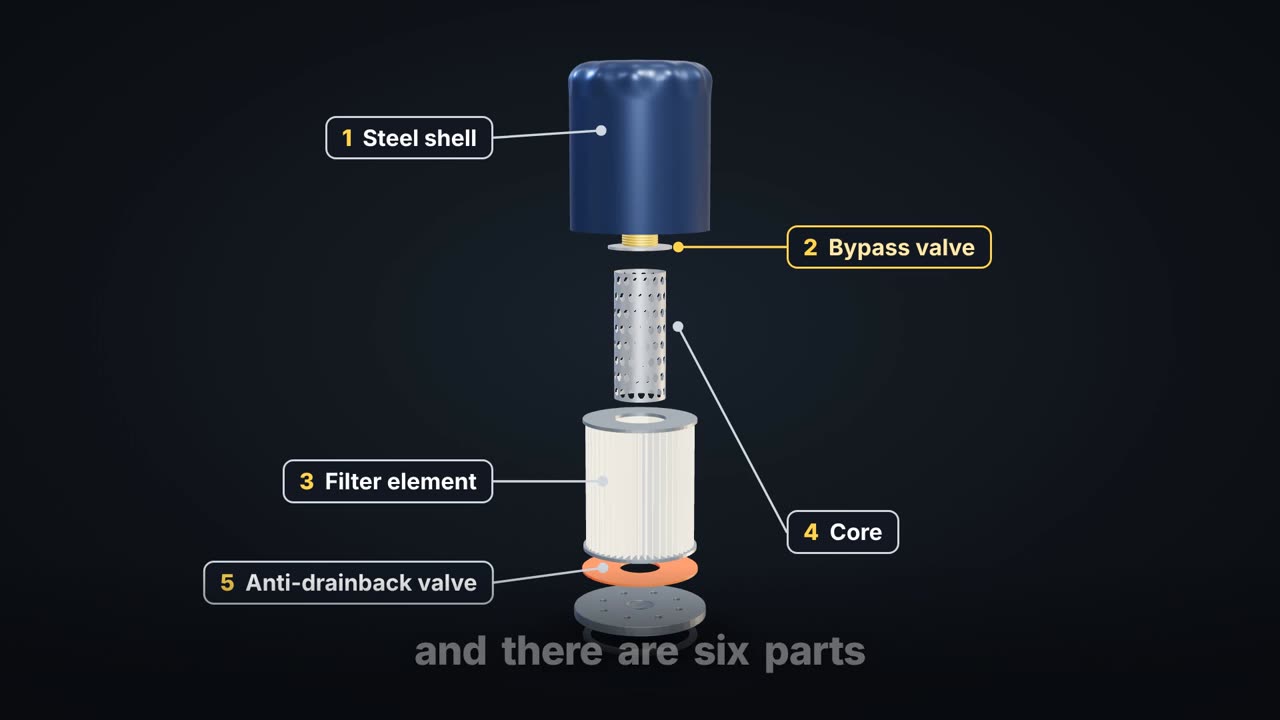
Watch the filter come apart - 83 seconds: An exploded view of all six parts, the path the oil takes, and what the bypass valve does.
- Steel shell (the can). Holds everything and has to withstand the pressure and temperature swings of the engine. On a spin-on filter the whole can is thrown away with the element.[1]
- Bypass (relief) valve. A spring and a disc at the closed end. If the element clogs or the oil is too cold and thick to pass through it, the valve opens and oil goes around the element, unfiltered, instead of the engine going without.[1] [11]
- Filter element (the media). Pleated media that traps dirt, metal shavings and combustion byproducts. The pleats fit more surface area into a small can, but FRAM notes that the media material matters more than the number of pleats.[1]
- Core (center tube). A perforated steel or nylon tube inside the element that keeps the pleats from collapsing under pressure. End caps at each end support the element.[1]
- Anti-drainback valve. A rubber flap over the inlet holes that keeps oil from draining out of the filter when the engine is off, so oil is there the moment the engine restarts.[1]
- Base plate and gasket. The threaded steel plate that screws onto the engine, with a ring of small inlet holes and one large outlet in the center. The rubber gasket on its face seals the filter to the engine.[1]
How oil moves through the filter
With the engine running, the oil pump pushes oil into the filter through the ring of small inlet holes in the base plate. It flows around the outside of the element, through the media, into the center tube, and back to the engine through the threaded center hole. Dirt, metal shavings and combustion byproducts stay behind in the media.[1]
The bypass valve is the part that surprises people. It opens when the element is too clogged, or the oil too cold and thick, to get enough oil through. Oil then goes around the element and reaches the engine unfiltered. That is on purpose: Donaldson calls it the principle that "dirty oil is better than no oil", and FRAM says the same. Bypassing for a moment, usually on a cold start, is what it is for. A filter left on long enough to clog keeps passing oil through the bypass, but it has stopped cleaning it.[1] [11] [2]
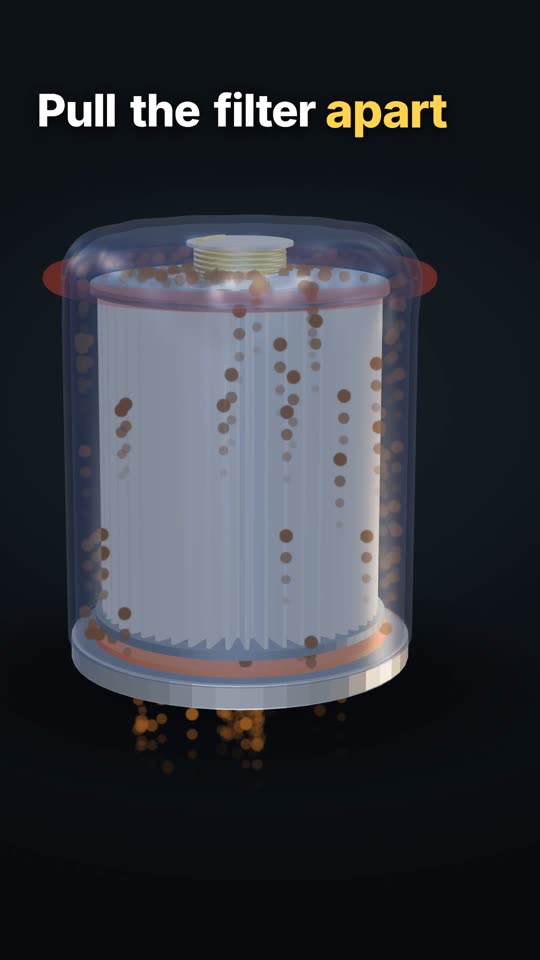
The bypass valve in 32 seconds: When the element clogs or the oil is cold and thick, the valve opens and oil goes around the pleats.
A bypass valve inside a filter is not the same thing as a "bypass filter": that is a separate, finer filter some engines run on a side loop to polish the oil. Bypass filter vs bypass valve (11-minute video), or watch a 2-minute cutaway of the valve opening.[11] [12]
The anti-drainback valve works the other way round: with the engine off, it seals the inlet holes so the oil in the filter does not drain out, and oil is ready the moment the engine restarts.[1]
Types of oil filters
Spin-on or cartridge. A spin-on filter is the whole can: shell, element and valves, replaced as one. A cartridge filter is only the element and its gaskets or O-rings. It goes into a permanent housing bolted to the engine, which has its own bypass valve and is not replaced. Several carmakers moved to cartridges to cut weight and the amount thrown away. Your engine is built for one or the other.[1]
The media. This is where the tiers really differ. FRAM describes three kinds:[1]
- Cellulose (paper fibers): balances efficiency and capacity, suited to standard vehicles on conventional oil change intervals.[1]
- Synthetic blend (cellulose with synthetic fibers): better efficiency without giving up capacity.[1]
- Full synthetic: high efficiency and high capacity, for heavy-duty and high-performance engines and extended oil change intervals.[1]
The valve and gasket materials. Nitrile anti-drainback valves are common in standard filters, and FRAM says they can turn brittle and crack with heat. Silicone lasts longer: FRAM rates its silicone valves at more than three times the life of nitrile in the SAE HS806 hot-oil test, and now lists them from its Extra Guard up (not on every part number). WIX lists silicone on the XP. Gaskets move up to high-temperature nitrile on FRAM's Ultra Synthetic and ethylene acrylic on the WIX XP.[1] [4] [6] [9]
Efficiency, capacity and flow: the three numbers that matter
Every oil filter is a balance of three things, in the words of both FRAM and Donaldson:[1] [11]
- Efficiency: how much of the dirt of a given size it catches, given as a percentage at a particle size in microns (a micron is a millionth of a meter). The common test size is 20 microns.[1] [2]
- Capacity: how much dirt it can hold before it is full. A full filter opens its bypass valve and stops cleaning.[2] [12]
- Restriction (flow): how easily oil passes through. Too restrictive, and the bypass valve opens to keep the engine fed.[2]
A percentage means nothing without its particle size. FRAM's own example: a filter that catches 95% at 20 microns may catch only 50% at 10 microns. And the brands do not all test at the same size: FRAM quotes 20 microns under the ISO 4548-12 test, WIX quotes 23 microns for the XP, and Mobil quotes 30 microns. So "99%" on one box and "99%" on another are not the same claim. Compare filters only at the same particle size.[2] [4] [9] [10]
The tiers, side by side: FRAM, WIX and Mobil 1
Each brand sells the same part number in several tiers. Here is what each maker says about its own lines. Mileage is how long the maker says the filter is built to protect, not when your car needs it changed.
FRAM
| Line | Media | Efficiency (maker's claim) | Rated miles | Notes |
|---|---|---|---|---|
| FRAM Drive[3] Shop on Amazon | Synthetic blend "OE grade" media | Not stated on the line-up page | 7,500 | For everyday drivers |
| FRAM Extra Guard[4] [3] Shop on Amazon | Fiber and resin blend | 95% of particles larger than 20 microns (ISO 4548-12) | 10,000 | Everyday driving, "built for OE recommended oil change intervals" |
| FRAM Tough Guard[5] [3] Shop on Amazon | Synthetic fiber and cellulose blend | 99% of particles larger than 20 microns (ISO 4548-12) | 15,000 | Stop-and-go traffic and towing; silicone anti-drainback valve, relief valve with a glass-fiber nylon poppet |
| FRAM Ultra Synthetic[6] Shop on Amazon | Dual-layer synthetic blend | 99%+ of particles larger than 20 microns (ISO 4548-12) | 20,000 with an appropriate synthetic oil | Metal center tube; FRAM adds: follow the change interval in your owner's manual |
| FRAM Titanium[7] Shop on Amazon | Synthetic blend on a metal screen | 99%+ of particles larger than 20 microns (ISO 4548-12) | 20,000 | High-flow inlet holes, textured grip |
| FRAM Synthetic Endurance[3] [1] Shop on Amazon | Synthetic, for synthetic oil | 99% | 25,000 | FRAM's longest-rated line; silicone anti-drainback valve |
WIX
| Line | Media | Efficiency (maker's claim) | Rated miles | Notes |
|---|---|---|---|---|
| WIX ProTec[8] Shop on Amazon | Cellulose and resin | Not stated on the line page | 10,000 | Everyday normal driving |
| WIX Premium[8] Shop on Amazon | Synthetic-blended | Not stated on the line page | 15,000 | Synthetic and high-mileage oils |
| WIX XP[9] [8] Shop on Amazon | Cellulose fibers and micro glass (XP page; the line page says hybridized synthetic fibers) | Over 99% at 23 microns, measured on the 51515XP | 20,000 with full-synthetic oil | Towing and hauling; silicone anti-drainback valve, metal end caps |
Mobil 1
| Line | Media | Efficiency (maker's claim) | Rated miles | Notes |
|---|---|---|---|---|
| Mobil 1 Extended Performance[10] Shop on Amazon | Synthetic blend | 99%+ of particles larger than 30 microns | Up to one year or 20,000 miles, whichever comes first (FAQ; one product page says 25,000) | Can be used with any motor oil type |
As an Amazon Associate ServiceSage Auto earns from qualifying purchases.
Before you buy: Amazon search results show every size in a line. Before you buy, match the exact part number to your engine with the maker's lookup or Amazon's "fits your vehicle" check. The tier only matters once the part fits.[1]
Is a more expensive filter always better?
No - it is built to last longer, which only pays if you keep it on longer. Going up a tier mostly buys capacity and durability: more synthetic in the media, a better gasket, a metal center tube or screen, and a higher mileage rating. Those matter when the filter stays on for a long interval or a hard life. They do little for a filter that comes off at 5,000 miles.[4] [5] [6] [8]
The filter's rating never sets your change interval. FRAM says to change the filter every time you change the oil, and to follow the interval in your owner's manual; Mobil says it tests its filter at twice the carmaker's interval. So a long-life filter is headroom, not permission to stretch the oil change.[3] [6] [10]
Is finer filtering always better? Not on its own. Catching smaller particles takes denser media, and denser media resists flow more and can fill up sooner. FRAM puts it plainly: a filter with high efficiency but limited capacity can clog quickly, and a clogged filter opens its bypass valve and sends unfiltered oil to the engine. The premium lines get around this with synthetic fibers, which catch finer dirt while still flowing and holding more. That is what the extra money is for. FRAM also notes that turbocharged and high-performance engines with tight tolerances benefit most from finer filtering, while standard engines may not need it.[2] [12] [11]
| Your situation | What to buy | Examples |
|---|---|---|
| Conventional or blend oil, normal driving, oil changed every 3,000-7,500 miles | The base tier, in the right part number. Its rating already covers your interval. | FRAM Extra Guard (10,000), WIX ProTec (10,000) |
| Synthetic oil at 7,500-10,000 miles, or towing, stop-and-go traffic, dust or extreme heat or cold | The middle tier: synthetic blend media rated for 15,000 miles. | FRAM Tough Guard (15,000), WIX Premium (15,000) |
| Synthetic oil on a long interval (10,000 miles or more, or an oil life monitor that runs long), or a turbo or high-performance engine | A top tier rated past your interval. | FRAM Ultra Synthetic or Titanium (20,000), WIX XP (20,000), Mobil 1 Extended Performance (one year or 20,000) |
| Not sure what your engine needs | The filter your owner's manual specifies, or one sold as meeting that specification. | Your owner's manual names it |
Ratings from[4] [5] [6] [7] [8] [9] [10] [1]
Above all, fit comes first. FRAM is blunt about it: oil filters are not universal, and different engines require different filters. The part number is what matches the size, thread and valves to your engine, so a top-tier filter in the wrong part number is worse than a base filter in the right one.[1]
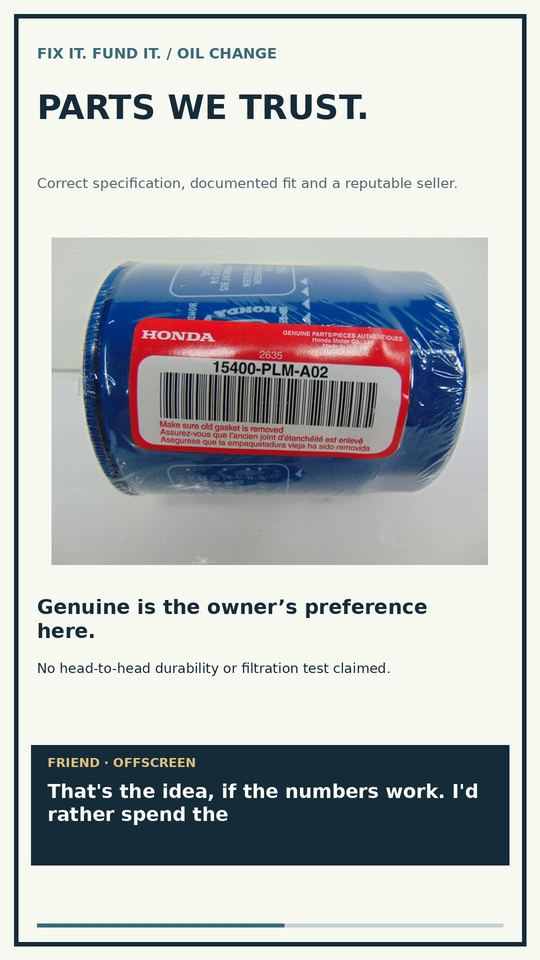
Is the genuine filter worth it? - 37 seconds: Two DIYers weigh the genuine Honda filter against the cost of the whole oil change, not just the filter.
When to change the filter, and how to fit it
Change the filter when your car's schedule says. FRAM's advice is to change it every time you change the oil, and many schedules list engine oil and filter as one job. FRAM warns that a filter left on past its interval becomes saturated and can cycle dirty oil back through the engine. See how often to change your oil, or pick your car in the maintenance schedules for its own interval and oil filter.[3]
Hondas are the exception worth knowing. Honda's Maintenance Minder splits the job: an A service is engine oil only, and a B service is engine oil and the oil filter, plus an inspection. Decode any code in the Honda Maintenance Minder guide.[13]
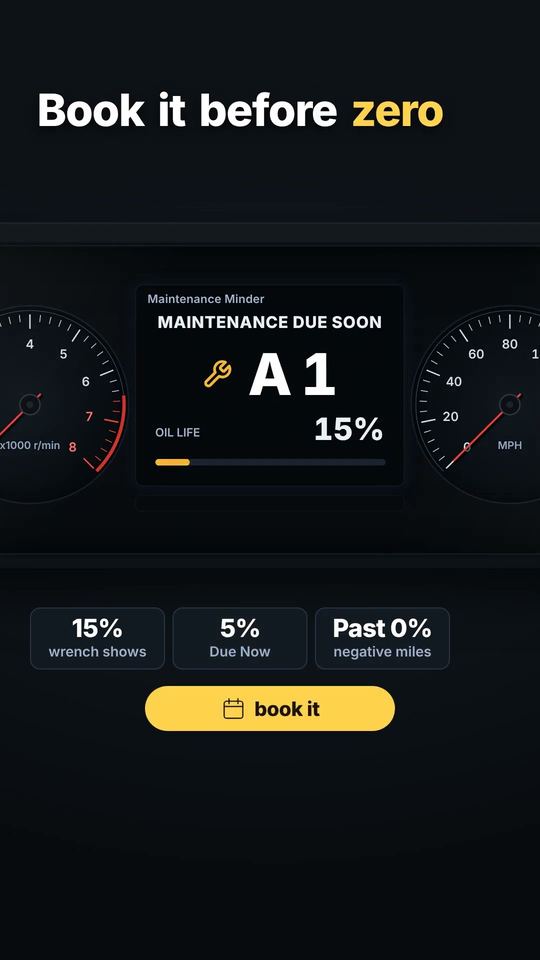
Why a Honda A service has no filter - 32 seconds: Honda A = engine oil only. The filter belongs to the B service.
Fitting a spin-on filter, from FRAM's instructions:[4]
- Make sure the old filter's gasket came off with it. Two gaskets stacked on the mount will leak.[4] [3]
- Wipe a film of clean oil on the new gasket (not grease).[4]
- Screw it on until the gasket touches, then tighten as the filter's own instructions say. A filter that is loose or cross-threaded leaks.[4] [3]
- Fill with the oil your owner's manual names, idle for five minutes, check for leaks, then recheck the level.[4]
Full step-by-step job: the DIY oil change guide. The oil grade and capacity for your car: what fluids does my car take?
Get a free email before your next oil and filter change, and keep a log of each one with its date and mileage.
Oil filter questions
How does an oil filter work?
Oil enters through the small holes in the base plate, flows through the pleated media from the outside in, and leaves clean through the threaded center hole. The media traps dirt, metal shavings and combustion byproducts. An anti-drainback valve keeps oil in the filter when the engine is off, and a bypass valve lets oil around the element if it is clogged or the oil is too cold and thick.
What are the parts of an oil filter?
A spin-on filter has six: the steel shell, the bypass (relief) valve, the pleated filter element, the perforated core that keeps the pleats from collapsing, the anti-drainback valve, and the threaded base plate with its gasket.
Is a more expensive oil filter better?
It is built to last longer and hold more dirt, which pays off only if you keep it on longer. A pricier filter usually has more synthetic in its media, a sturdier build and a higher mileage rating (FRAM rates its lines from 7,500 to 25,000 miles). If you change your oil every 5,000 miles, a base filter rated for 10,000 already covers it. Buy a filter rated for at least your interval, in the right part number for your engine.
Is a finer oil filter always better?
No. Finer media catches smaller particles but resists flow more and can fill up sooner. A filter with high efficiency but limited capacity can clog quickly, and a clogged filter opens its bypass valve and sends unfiltered oil to the engine. Premium filters use synthetic fibers to filter finer while still flowing and holding more dirt.
Can I compare filter efficiency percentages between brands?
Only at the same particle size. FRAM quotes efficiency at 20 microns, WIX quotes 23 microns for the XP, and Mobil quotes 30 microns, so "99%" on two boxes can mean different things. A filter that catches 95% at 20 microns may catch only 50% at 10 microns.
What is the difference between a spin-on and a cartridge oil filter?
A spin-on filter is a complete sealed can that is replaced whole. A cartridge filter is only the element and its O-rings, fitted into a permanent housing on the engine that has its own bypass valve. Your engine is built for one or the other.
Do I need a synthetic oil filter for synthetic oil?
FRAM recommends a filter designed for synthetic oil when you run synthetic, because synthetic media handles the longer intervals. What matters is that the filter is rated for at least as long as your oil stays in.
Does a Honda need a new oil filter at every oil change?
Not by Honda's schedule. On a Maintenance Minder Honda, an A service is engine oil only and a B service is engine oil and the oil filter, plus an inspection.
Sources
- FRAM, How Oil Filters Work (2024)
- FRAM, Oil Filter Capacity, Flow Rate, Efficiency, and Micron Rating (2025)
- FRAM, Engine Oil Filters (product line-up)
- FRAM, Extra Guard oil filter
- FRAM, Tough Guard oil filter
- FRAM, Ultra Synthetic oil filter
- FRAM, Titanium oil filter
- WIX Filters, Passenger Car and Light Truck Oil Filters
- WIX Filters, WIX XP Oil Filters
- Mobil, Mobil 1 Extended Performance oil filters FAQs
- Donaldson, The Importance of Lube Filtration
- Donaldson, Full-Flow vs. By-Pass Lube Filtration
- Honda, 2024 Civic Owner's Manual, Maintenance Minder section